


Couch & TifTuf
An affordable foundation, a lighter routine for TifTuf, and premium options including Noculate Complete for low-cut turf.
Download couch programKnow your lawn. Plan the next job. Make every drop and dollar count.
Draw it on the map, or enter your measured area below. Your product and watering tools use this lawn size.
Find your address, outline each lawn area and get an estimate in square metres.
Tap each corner, then tap the first point to close the outline. Select a completed outline to move its corners. Outline overlapping lawn areas only once; the total also removes any overlap automatically.
This is an estimate, not a survey. Aerial images can be older or hide edges beneath trees. Check uncertain boundaries on the ground before working out product quantities.
Device saves stay in this browser. Choose Save to keep this lawn's settings and map outlines; use New lawn for another property. Account syncing is not connected yet.
Enter your area and depth. Get the volume for your next job.
1 ha = 10,000 m²
The starting density is a guide. Enter your supplier’s density and price for a material estimate.
Enter your area and depth to see the volume.
Weight uses the selected material’s density. Add a price in the optional settings to estimate material cost.
Volume = area in m² × depth in mm ÷ 1,000. Tonnes = volume × bulk density. Confirm the material, suitable depth and density with your supplier. Estimates exclude settling, delivery and labour.
Save your grass variety and postcode for a local weather guide to help keep your established lawn healthy and green.
Your lawn weatherYour lawn details and watering log stay on this device.
Choose your grass and postcode, then save your lawn to see rainfall, the forecast and a weather-informed watering estimate.
Check the soil as well as the sky. A forecast cannot measure moisture in your lawn.Weather data by Visual Crossing
This weather is out of date. Refresh it before using a watering estimate.
Illustrative preview only. These are sample weather values, not live observations or advice for your lawn.
The last 7 and 30 complete local days, through yesterday. Location-based rainfall can differ from the rain received on your lawn.
A complete, current forecast and an established, actively growing lawn are needed for this estimate.
Estimated demand before future rain for healthy, established, actively growing lawn. The upper end supports lush growth; rain received and soil moisture determine what to apply.
Forecast rain has not reached your lawn yet. Check the actual rain received before adjusting an application.
A planning budget from recent weather and your watering log. Check soil moisture and use suitable sessions; the total is not a single watering dose.
Weather suitability only. Confirm your permitted days and times; local watering rules always apply.
Total time based on your catch-cup measurement. Plan suitable sessions and pause if water runs off.
This total is longer than the weather window shown. Spread any watering across suitable sessions and recheck the soil.
Today shows the remaining forecast. Forecast amounts may change; check conditions before watering.
Log the water your lawn received so it is counted in the recent replacement budget. These entries belong to this saved lawn on this device.
Showing the 10 most recent entries.
Your dashboard is loading. If it stays here, refresh this page and try again.
Choose your lawn, then see what each pack covers and costs.
Enter the lawn area for this plan.
Measure your sprayer’s coverage to convert a water-based label rate into a lawn quantity.
Choose a label rate / target
These calculators are helpful guides. Always read the product label before applying.
Add a product to see your pack coverage and budget here.
Save your plan to keep it for next time.
Practical seasonal plans built around TPG Enhance and the essentials your lawn needs. Download a free guide, start with core care, and choose extras for a specific job.
Each guide includes a seasonal calendar, quantities for 100 m² and a shopping list. Designed for established lawns in VIC, SA, TAS and southern NSW (Sydney and south). Adjust timing to local growth and weather.
An affordable foundation, a lighter routine for TifTuf, and premium options including Noculate Complete for low-cut turf.
Download couch programSeasonal feeding and mowing guidance, plus Oxafert weed prevention and premium options matched to buffalo.
Download buffalo programMeasured feeding and regular mowing, with Oxafert weed prevention and Amigo growth management as optional next steps.
Download kikuyu programFree to download. No signup required. Product prices in the PDFs were checked on 10 October 2026; check the product pages before buying.
TPG Enhance is the affordable nutrition foundation. Amplify is our flagship seaweed product, and Deluge Duo is our wetting-agent choice. Choose the support your lawn needs.
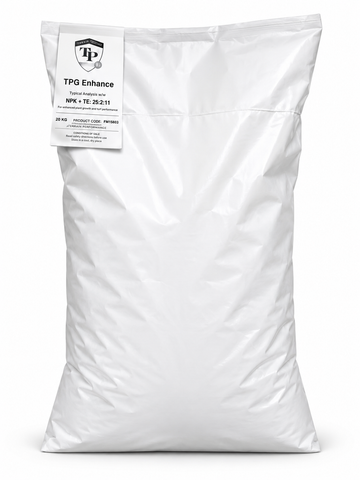
A granular feed for established lawns. Published rate: 2–3kg per 100 m². These essentials guides use the lower 2kg starting rate.
About $9.08 of product per 100 m² feed at 2kg. One 20kg bag provides ten feeds at that rate.
Shop TPG Enhance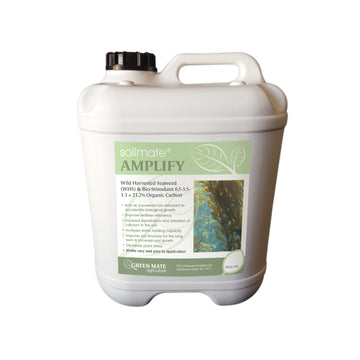
Seaweed biostimulant plus carbon for soil support. Our featured seaweed product, with a 1L option for home lawns.
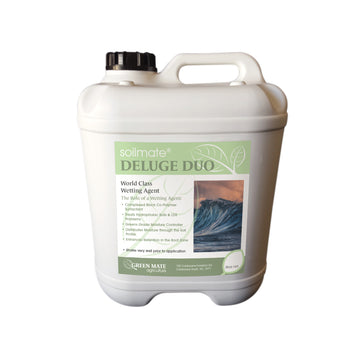
For water-repellent soil and dry patch, with support for moisture movement and retention. The 1L pack keeps the upfront outlay lower; larger sizes are available.
Buying the three shown packs individually totals $141.90. Start with core nutrition and add only what your lawn needs.
For low-cut turf, extra colour or more control over growth, these are our featured next-step products. Match the product to the surface, conditions and result you want.

A 17-1-14 greens-grade fertiliser for closely mown, high-quality turf. An alternative granular foundation for a tailored low-cut program.

A nitrogen and iron feed for a colour and growth boost. Account for its nutrition in your feeding plan and match the application to lawn condition.
Packaging image shows 10L; the price and link below are for 5L.
Manage leaf and stem growth on actively growing turf. Choose 1L or 5L, and match the label rate to grass type and mowing regime.
Premium options are chosen for a specific job. Noculate Complete can replace TPG Enhance in a low-cut program; the guides do not prescribe both granular feeds together. Ask your mate to tailor the rates and timing.
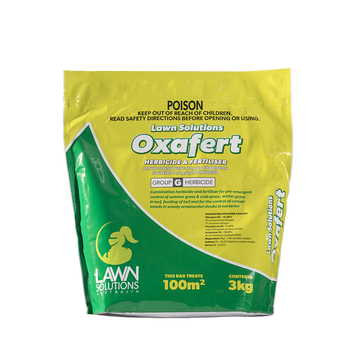
Pre-emergent herbicide and fertiliser for buffalo and kikuyu when both weed prevention and nutrition are needed. Apply before the target weeds germinate, following the label on your pack.
A 3kg bag covers 100 m² at the 3kg summer-grass rate. The winter-grass rate is 4kg per 100 m². Account for its fertiliser in the program. Do not use on Santa Ana, newly seeded turf, putting greens, low-cut tees or bowling greens.
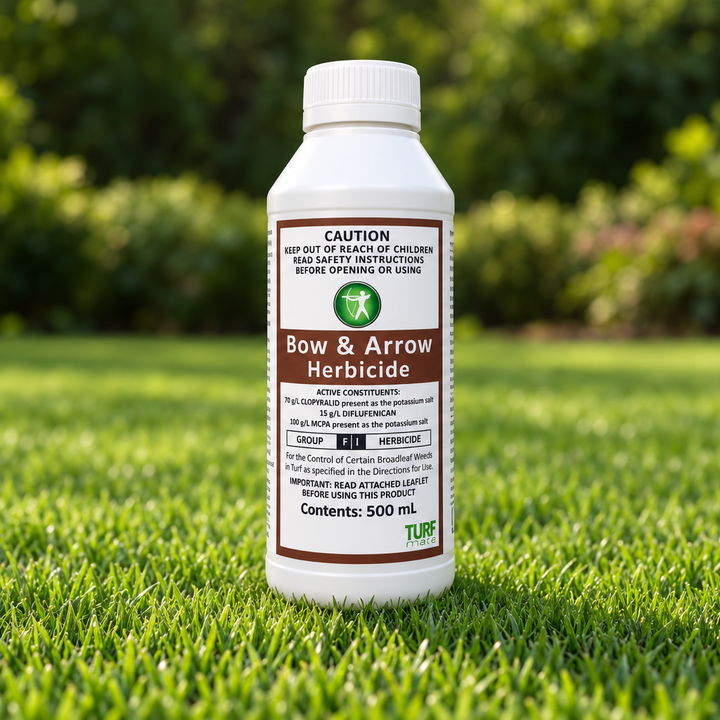
A selective liquid treatment for existing, actively growing broadleaf weeds listed on the label, including clover, bindii and creeping oxalis.
At 50mL per 100 m², a 500mL bottle provides enough product for 1,000 m² total treatment area. Product used per 100 m²: $5.50. Sprayer extra.
This is broadleaf weed treatment; Oxafert is the prevention option above. Test a small area on buffalo first, especially older ST varieties. Kikuyu may temporarily discolour. Check the label for full directions and restrictions.
Read the manufacturer labelShop Bow & Arrow 500mLThe calendars are starting points, not automatic monthly dosing. Match feeding to growth, follow current product directions and water in as directed. Ask your mate about weeds, pests, disease, mixing products or a more involved program.
Get help with my lawnA controlled-release granular option for ongoing turf nutrition programs, with approximately 2–3 months of feeding depending on conditions. Use it as the granular feed component and account for its nutrient release before scheduling another full-rate granular fertiliser.
Apply 2–3.5kg per 100m²; the average recommended rate is 2.75kg per 100m². At that average rate, product used costs approximately $10.78 before GST ($11.86 including GST) per 100m² per application. Select rates for your turf and conditions and follow the bag label.
25kg bag: $98 + GST ($107.80 including GST).
View ProTurf Hi N ↗Tell us what you’re working on. Send your grass type, location and a few clear photos so we can help with the next step.
sales@turfmate.com.au ↗


Available in 5L, 10L, 20L and 200L. The photo shows our 10L pack. Your order will be supplied in the size you select above.
Liquid nitrogen + iron fertiliser
Nitro Iron is our premium colour and nitrogen/iron option. Account for the nitrogen contribution when planning granular feeds.
Home lawns and managed turf; home-lawn guidance and greens/tees/fairways guidance are different.
| Target / situation | Product per 100 m² | Product per hectare |
|---|---|---|
| Published home-lawn guidance | 0.5–1.5 L | Home-lawn direction; do not replace the trade program |
| Greens, tees, fairways and ovals | 200–500 mL equivalent | 20–50 L |
Selected manufacturer guidance only. Figures marked “equivalent” are area conversions. 1 hectare = 10,000 m².
Use sufficient water to thoroughly wet foliage and reach the root zone. No fixed carrier volume is published in the available product guidance.
The dose is based on the area treated. Calibrate using clean water, then scale the product and carrier volume for that area. Use only equipment permitted by the full label; the table is not a fixed tank-mix recipe.
Use the target-specific hectare rate and carrier volume above. Follow all equipment, droplet, drift and irrigation directions in the full label.
Send us your lawn variety, area, location and clear photos. We can help match the product and application program to your home or commercial surface.
Email sales@turfmate.com.au ↗Read the complete product label and SDS before use. Wear the specified PPE and follow all state, site, re-entry, withholding and environmental requirements. Do not substitute an SDS, brochure or website summary for the label.
Available in 5L, 10L and 200L. The photo shows our 10L pack. Your order will be supplied in the size you select above.
*PLEASE SELECT SIZE IN DROP DOWN BOX*
A premium quality high nutrient fertiliser with a thick rich organic kelp base containing a wide range of essential trace elements in chelated form for easy application onto your lawn or garden.
Application Rates:
Dilution minimum 1:50. 20L-50L per hectare
200ml-500ml per 100m2
+ Trace Elements:
Sulfur, Calcium, Magnesium, Zinc, Boron, Copper, Iron, Manganese, Molybdenum, Cobalt, Iodine, Selenium.
Typical Analysis
| Nitrogen | 22% |
| Phosphorus | 5% |
| Potassium | 6% |
Click here for our Safety Data Sheet
Available in 5L, 10L and 200L. Packaging pictured is representative. Your order will be supplied in the size you select above.
*PLEASE SELECT SIZE IN DROP DOWN BOX*
Chelated Iron plus Trace Elements.
A premium liquid iron chelate based on natural polysaccharide agents. Supported with fulvic acids, kelp, saponins and vermicast extract which improve nutrient uptake and translocation.
Additional trace elements are included to avoid any hidden deficiencies.
APPLICATION INSTRUCTIONS
Application Rates:
10-30L/Hectare; 300-450ml/100sqm
Dilution Rate:
1:50 or as advised
Typical Analysis:
|
MAJOR ELEMENTS |
% W/V |
|
Iron |
6.0% |
|
Sulfur |
3.5% |
|
Liquid Sugar |
10.0% |
|
Fulvix |
6.0% |
Available in 5L, 10L and 200L. Packaging pictured is representative. Your order will be supplied in the size you select above.
*PLEASE SELECT SIZE IN DROP DOWN BOX*
A premium quality high nutrient fertiliser with a thick rich organic kelp base containing a wide range of essential trace elements in chelated form for easy application onto your lawn or garden.
APPLICATION INSTRUCTIONS
Application Rates:
200-500ml per 100m2
Foliar: 15-30 Litres per Hectare
Watered in: 20-50 Litres per Hectare
Dilution Rate:
1:20 or as advised
Typical Analysis
| Nitrogen | 18.4% |
| Phosphorus |
6.7% |
| Potassium |
14.10% |
| Fulvic Acid | 3.0% |
| Carbohydrates | 12.0% |
Click here for our Safety Data Sheet
WHAT IS CHARLIE CARP?
Charlie Carp is an innovation in liquid fish fertiliser. Not only is it the best natural fertiliser on the market for your lawn and garden, it also helps to sustain a healthy environment and stabilise the natural ecosystem here in Australia.
We supply liquid fish fertiliser in its purest form by using the whole fish and adding nothing else in the manufacturing process. Charlie Carp fish fertiliser provides an almost perfect balance to deliver plants and grass enough nutrients they need for healthy growth. It contains both micro and macro nutrients that help to give you long-lasting results in the colour and health of your garden or lawn.
Soil health will also prosper with Charlie Carp. Fish fertiliser has been proven to improve soil quality, leading to enhanced, deeper rooting due to the better penetration of nutrients and water. It can also rebuild and replenish older, unproductive soil, bringing it back to life.
Perfect for everything your garden grows we use the whole fish so Charlie Carp is full of all the vitamins and minerals essential for a beautiful garden and lawn. Economical and easy to apply Charlie Carp goes to work immediately creating a healthy immune system and strong growth……not only are we growing beautiful gardens and lawns…we are cleaning up the waterways of Australia.
For bulk fertilising through the watering systems and boom sprays. This product can also be effective and economical domestically.
This can be applied directly to the plant or lawn either on the roots through the soil or poured over the plant itself.
Use Charlie Carp for all plants & shrubs including: Lawns, Vegetables, Flowers, Indoor Plants, Hanging Baskets, Strawberries, Palms, Orchids, Roses, Ferns, Native Shrubs, Seedlings, Herbs.
Charlie Carp good for everything your garden grows
|
HOME GARDEN APPLICATION RATES |
(SEE FURTHER DOWN FOR COMMERCIAL RATES)
|
Application |
Mixing Instructions |
Rate per 9L Water
|
Frequency |
|
Established garden Including: Succulents, Gardenias, Roses, Hedges, all Flowering Shrubs and Trees |
Shake bottle well before mixing with water. Mix 1 capful of Charlie Carp to 1 litre of water, or 9 capfuls to a standard 9 litre watering can. This covers approx. 10 sq metres of garden. Repeat monthly for best results or fortnightly in the peak growing months. |
90ml |
Monthly |
|
Camellias & Azaleas |
Shake bottle well before mixing. Mix 1 capful of Charlie Carp to 2 litres of water, or 4.5 capfuls to a standard 9 litre watering can, covering 10 square metres of lawn. Repeat monthly during the growing season – Spring and Summer. |
45ml |
Monthly |
|
Ferns and indoor plants |
Shake bottle well before mixing with water. Apply 1 capful of Charlie Carp to 3 litres of water. Or 3 capfuls to a standard 9 litre watering can. Apply liberally to foliage and root system every 2-4 weeks. |
30ml |
2-4 weeks during growing season |
|
Lawns |
Shake bottle well before mixing. Mix 1 capful of Charlie Carp to 2 litres of water, or 4.5 capfuls to a standard 9 litre watering can, covering 10 square metres of lawn. Repeat monthly during the growing season – Spring and Summer. The 2.2 litre spray pack is definitely the way to go for lawns. |
45ml |
Monthly during growing season |
|
Vegetables, Herbs, Fruits and Annuals |
Shake bottle well before mixing with water. Mix one capful of Charlie Carp to 2 litres of water. For quicker results or an instant boost, mix one capful of Charlie Carp to 1 Litre of water and repeat every 2-4 weeks on the growing season. |
45ml to 90ml |
2-4 weeks during growing season |
|
Native Plants |
Shake bottle well before mixing with water. Mix 1 capful of Charlie Carp to 2 litres of water, or 4.5 capfuls to a standard 9 litre watering can, covering 10 square metres of lawn. Repeat monthly during the growing season – Spring and Summer. |
45ml |
Monthly |
|
Transplanting and Planting |
Shake bottle well before mixing with water. Mix 1 capful of Charlie Carp to 2 litres of water. Or, 4.5 capfuls to a standard 9 litre watering can. Apply sufficient amount to soak all foliage with the watering can. Then soak around the roots for an added boost. Apply at planting time and then again 2 weeks later. |
45ml |
At planting and again 2 weeks later |
|
Seedlings |
Shake bottle well before mixing with water. Mix one capful of Charlie Carp to 2 litres of water. Or, 4.5 capfuls to a 9 litre watering can. Water over foliage with the watering can. Apply again 2 weeks later. |
45ml |
At planting and again 2 weeks later |
Seaweed biostimulant + carbon
Soil Mate Amplify is our flagship seaweed and organic-carbon biostimulant. Use it as measured soil support within a nutrition program.
Turf and other labelled horticultural situations; soil-directed nutrition and biostimulant support.
| Target / situation | Product per 100 m² | Product per hectare |
|---|---|---|
| Manufacturer application guidance | 40 mL | 4 L |
Selected manufacturer guidance only. Figures marked “equivalent” are area conversions. 1 hectare = 10,000 m².
Dilute for even coverage of the measured area. Manufacturer guidance does not specify one universal spray-water volume.
The dose is based on the area treated. Calibrate using clean water, then scale the product and carrier volume for that area. Use only equipment permitted by the full label; the table is not a fixed tank-mix recipe.
Use the target-specific hectare rate and carrier volume above. Follow all equipment, droplet, drift and irrigation directions in the full label.
Use the Turf Library to check symptoms and identification. A guide is not proof that every lawn or site is suitable for this product.
Send us your lawn variety, area, location and clear photos. We can help match the product and application program to your home or commercial surface.
Email sales@turfmate.com.au ↗Read the complete product label and SDS before use. Wear the specified PPE and follow all state, site, re-entry, withholding and environmental requirements. Do not substitute an SDS, brochure or website summary for the label.
SOIL MATE REVIVAL 0.5-3.5 + 1.1 BACILLUS BACTERIA + ORGANIC CARBON
PROUDLY MANUFACTURED IN MELBOURNE
Soilmate revival contains almost every micro-nutrient in a fully chelated (immediately available) form. The wild harvested seaweed is also loaded with carbohydrates which plants use as a building block. Numerous beneficial micro-organisms also use carbohydrates as a food source (especially the alginates in the seaweed) that act as soil conditioners. Seaweed also contains alginic acid and mannitol, which are carbohydrates with chelating ability. Chelates are large organic molecules which encircle and hold trace elements enabling plants to effectively absorb micro-nutrients that are generally in ‘unavailable’ forms. The alginates react with metals in the soil and form long, cross-linked polymers, these polymers improve the crumbling in the soil, swell up when they get wet and retain moisture for long periods.
WHS Fertiliser Contains Specific Active Micro-Organisms & Nutrients Including: + Bacillus subtilis
1. Promoting Plant Growth. Bacillus subtilis can secrete active substances that can promote plant growth, flowering and fruiting, which helps increase yield and income.
2. Improve Soil Structure. Bacillus subtilis in agriculture can significantly increase soil alkaline nitrogen, phosphorus content, available potassium, and total potassium content. It can also improve and regulate nutrients in the plow layer, thereby regulating soil nutrients, changing soil microbial flora structure and decomposition of pesticide residues in soil.
3. Improve Crop Quality. After Bacillus subtilis colonizes in the soil, it will produce a large number of plant hormones and organic acids, forming a benign plant-soil-microbial ecosystem, thereby effectively improving crop quality
+ Bacillus mucilaginosus Dissolves P & K, making it more plant available, fixes N, promotes plants growth, improves immune health leading to reduced disease pressure, can flourish in a wide range of pH and can has a high floculating effect
+ Bacillus licheniformis Cycles nutrients in the soil, produces antifungal compounds that can protect the plant from pathogen attack, can withstand high pH and high and low soil temperatures and other environmental stresses
+ Bacillus megatrium Produces phosphate and potassium fixing fertilisers, degrades organic P in the soil, reduces pesticide residuals in the soil, outcompetes pathogen activity at the rhizosphere, speeds up growth in new plantings
+ Brevibacillus laterosporus Is a pathogen to negative invertebrates, excretes antimicrobial compounds against certain pathogenic bacteria, fungi and pathogenic nematodes species
+ Cellulose Utilisers
Like Trichoderma spp require only minerals and cellulose for growth. These fungi break down plant remains into organic materials that are beneficial to other micro-organisms such as Protozoa.
+ Nutrients
Highly efficient phosphate solubilising bacteria that secrete organic acids that can mobilise insoluble nutrients like Phosphorus. Active in soil organic matter breakdown and turnover. Nitrogen fixing and mineral dissolving soil bacterial. Application on one hand allows enriching the root space by the mobile nitrogen, phosphorus and potassium and on the other hand allows reducing excessive spending of mineral fertilizers Potential to dissolve soil minerals (releasing potassium).
• Stimulates Existing Soil Microbes
• Establishes Improved Bio Energy Foundation
• Reduces Disease and Stress Problems
• Improves Soil Aggregation & Biodiversity
• Enhances Rooting and Soil Aeration
APPLICATION RATES:
40ml-60ml/100m2 once every 8-12 weeks
For best results use in conjunction with Soil Mate Amplify to feed your microbes
ferA high-analysis source of micronised natural gypsum combined in a free-flowing suspension with fulvic acid. The soil conditioning capacity of gypsum is dramatically magnified with the huge increase in surface area associated with micronisation.
BENEFITS:
 Gardening
Soil Mate Elevate Wild Harvested Seaweed (WHS) Fertiliser 0.5-3.5-1.1
PROUDLY MANUFACTURED IN MELBOURNE
This liquid seaweed fertiliser contains almost every micro-nutrient in a fully chelated (immediately available) form. The wild harvested seaweed is also loaded with carbohydrates which plants use as a building block. Numerous beneficial micro-organisms also use carbohydrates as a food source (especially the alginates in the seaweed) that act as soil conditioners. Seaweed also contains alginic acid and mannitol, which are carbohydrates with chelating ability. Chelates are large organic molecules which encircle and hold trace elements enabling plants to effectively absorb micro-nutrients that are generally in ‘unavailable’ forms. The alginates react with metals in the soil and form long, cross-linked polymers, these polymers improve the crumbling in the soil, swell up when they get wet and retain moisture for long periods.
Important Plant Hormones in Soil Mate Wild Harvested Liquid Seaweed Fertiliser
Another vital component of our WHS Liquid Seaweed Fertilisers are hormones. Seaweed contains four primary hormone types: auxins, cytokinins, betaines and gibbelerins. These hormones, although only required in very small proportions, are essential to plant health and vitality.
+ Auxins
There are many different auxins, and they all have a specific role. The primary function of auxins is to balance the plants speed of growth. They have both growth-stimulating and growth-delaying functions. They also stimulate root growth and prevent bud forming or bud opening at the wrong times. Seaweed plays an important role in the plant’s own auxins production as the hormones form with the help of trace elements from the liquid seaweed fertiliser.
+ Cytokinins
Cytokinins are another group of essential plant hormones. They initiate and activate basic growth processes. Cytokinins available in liquid seaweed stimulates growth with greater vigor because they mobilize nutrients in the leaves. They also provide protection from marginal frost (up to -3 Celsius). Cytokinins also control the senescence, loss of a cell’s power of division and growth (aging processes) in the plant.
+ Betaines
Betaines play an essential role in the osmotic processes in plants. They help to increase the water uptake in plants and are extremely helpful in dry conditions. Betaines are also particularly helpful to plants undergoing stress.
• Produces a higher yield of crop
• Plant growth stimulant
• Encourages germination of seeds and root growth
• Repels slugs and other pests
• Enriches the soil
• Contains natural growth hormones
• Boosts lethargic plants
• Helps lighten the soil
Application Rates
Soil Mate WHS can be applied through all farming equipment including boom sprays, pivots, knapsack sprayers etc.
For all types of spray equipment, use the area normally covered by one tankful to determine how much product to add.
4-6L/Ha application rate on all crop types.
40ml-60ml/100m2
Rapid Nitrogen + Fulvic Acid 23.2% N 0.5% Fulvic Acid
A revolutionary fertiliser, developed with a unique Nitrogen delivery technology that drives growth and increases the mineral density of your turf. It is a liquid urea combined with Fulvic acid and carbohydrates for improved plant and crop uptake
Many forms of nitrogen don't always all make it to the plant and turf. Many forms of N can be lost to the atmosphere and sub soils and pays very little regard to how much Nitrogen is actually getting into the plant. By changing this thought process and applying the Nitrogen in a dramatically more efficient manner, we are able to significantly reduce the amount of Nitrogen used to achieve the same results.
The form of Nitrogen found in Rapid N + Fulvic is extremely efficient for the plant to convert to protein, thus saving it valuable energy that the plant can then put towards increased growth. It increases the mineral density of the plant as the Nitrogen process ‘powers’ the sugar development in the plant.
The addition of Fulvic Acid allows the plant to draw in more nitrogen, giving you better uptake and better results.
Why Use Rapid N + Fulvic
Growth
Fertilises each individual plant or turf with enough Nitrogen to ensure excellent growth for 4 to 6 weeks. The efficiency of this product means that around 80-90% of Nitrogen applied is delivered to the plant.
Efficiency
It is efficient due to the combination of carbohydrate and Fulvic Acid that the quantity of product required is much lower than competitor products that boast being resource effective.
Synchronicity
It is possible to mix this with other Herbicides, Insecticides even some plant growth regulators. Allowing spraying to be done just in one hit. Saving heaps of time, money and the headache of doing multiple sprays.
Crop Safety
Rapid N + Fulvic is safe to the plant when used at rates between 25 to 40L/Ha. It will also not cause leaf burn.
• 23% N with Fulvic for rapid uptake
• Fulvic prevents immobilisation of nutrients
• Fulvic improves N uptake to the plant
• Reduces impact on soil biology
• Aids in germination at renovation
Application Rates
For the best results soil testing is required for accurate application rates.
Standard rate - 25–40 L/ha
250–400 mL per 100 m² (equivalent to 25–40 L/ha)
200L & 1000L Available - Contact Turfmate for pricing
Soil Mate Rapid-N + Fulvic Flyer
Turf guidance: current manufacturer turf application directions. Select the rate for your turf condition and confirm the current pack formulation and directions. Do not infer tank-mix compatibility from a general product description.
Once sold out, this will no longer be stocked!
PowerFeed is a fortified fish fertiliser, that is blended with liquid humus to produce a highly efficient complementary liquid feed with dual action benefits for plant growth and soil condition.
Typical Analysis:
W/V: Nitrogen (N) 14.0%. Phosphorus (P) 1.4%. Potassium (K) 8.0%
PowerFeed is an all-purpose plant fertiliser that also supports the growth and activity of biological communities in the soil. It provides both immediate and extended nutrient availability, together with ongoing benefits for improved soil structure and biological activity.
The Role of Power-N Fertiliser
A premium quality, high nutrient fertiliser formulated with readily plant-available source of Nitrogen with Carbon added to increase efficiency of uptake. This liquid form is made for ease of use in both fertigation and foliar applications.
Application Rates:
200-500ml/100m2 (20-50L/Ha)
Foliar:
5-30 litres Per Ha
Fertigation:
30-200 litres Per Ha
Dilution Rates:
1:20 or as advised

Turf Aid is a unique 3 part, liquid additive used to act as a visual spray application aid with a range of turf management products. In addition, the macrocyclic compound called phthalocyanine within the product also assists in protecting turf against UV radiation and excessive light intensity. The new generation APG surfactant in the formulation assists in improving coverage, uniformity, deposition and provides rainfast properties to the product, and it’s tank mix partners. Finally, the product contains Plant Elicitors which enhance the plant’s immune response to plant stresses.
Formulation: Soluble Concentrate
Click here for Label
Click here for Technote
Click here for SDS (Safety Data Sheet)
Soil Mate Rhizo-Boost Microbial Inoculate Formula is formulated
using our wild harvested seaweed combined with a blend of
naturally occurring beneficial soil micro-organisms. Together these
help to break down and increase the organic matter within the soil
freeing trapped carbon and other vital nutrients.
This biological formulation supports farmers in improving soil
health and the utilization rate of fertilizers by increasing the uptake
of plant nutrients and enhancing the resistance of diseases
and pathogens. Soil Mate Rhizo-Boost Formula will also assist in
better nutrient cycling to significantly improve the soil’s structure,
maximizing root growth and retain soil moisture.
+ Biological Nitrogen Fixation:
Process of assimilating atmospheric nitrogen into organic compounds, especially by microorganisms.
+ Phosphate Solubilization:
Process of solubilizing bound phosphate in the soil and making it available for uptake by plants.
+ Phytohormone Production
Process of using carbon sequestration to increase healthy plant hormones and storing carbon in the soil which drastically increases the amount of available nitrate nitrogen.
+ Mobilization and Mineralization
Process of mobilizing and mineralization of soil nutrients such as salt, phosphate, magnesium, and calcium into a form that is easily used by the plant.
+ Saprophytic Competence
Saprophytes live on decomposing and dead matter that helps the microbes in Soil Mate Rhizo-Boost Formula compete with the native soil microbes, allowing them to better perform their intended functions.
| Total Major Nutrients: | Unit |
| Nitrogen (N) | % 0.481 |
| Phosphorus (P) | % 3.52 |
| Potassium (K) | % 1.1 |
| Sulphur (S) | % 0.06 |
| Total Cations: | |
| Calcium (Ca) | % 0.0375 |
| Magnesium (Mg) | % 0.0244 |
| Sodium (Na) | % 0.474 |
| Total Minerals: | |
| Copper (Cu) | ppm 3.32 |
| Zinc (Zn) | ppm 8.64 |
| Iron (Fe) | ppm 3.33 |
| Manganese (Mn) | ppm 1.8 |
| Cobalt (Co) | ppm 0.12 |
| Molybdenum (Mo) | ppm 0.242 |
| Boron (B) | ppm 24.8 |
| Carbon Content: | |
| Organic Matter | % 3.8 |
| Organic Carbon | % 1.79 |
| Carbon/Nitrogen Ratio | C/N 4.28 |
| pH (1:5 Water) | 7.03 |
Soil Mate Rhizo-Boost can be applied through all farming
equipment including boom sprays, pivots, knapsack sprayers etc.
For all types of spray equipment, use the area normally covered
by one tankful to determine how much product to add.
2-4L/Ha application rate on all crop types.
| Sizes: 20L, 200L, 1000L |
Soil Mate Liqui-Cal 30% Calcium 4% Humic Acid
Micronised Liquid Calcium.
Regular use of plant available Calcium is often useful to improve available Calcium during the growing season in Organic Systems. Having the ability to fertigate or even foliar spray a high quality liquid Calcium serves as another method to help improve both the soil structure in the root zone as well as improving quality of produce being grown.
Application Rates
Watered in
20-100 litres per hectare or as advised
200–1,000 mL per 100 m² (equivalent to 20–100 L/ha)
Dilution rate
1:20 or as advised
Store in a cool place away from sunlight
Stir well before use
NASAA Organic Certified 3620M.
Some Of The Benefits Include:
• Rapid and efficient delivery of Calcium
• Improved cell wall strength & thickness
• Increased uptake of Calcium into the plant in season
• Plant available micronised Calcium source
Calcium aids in the formation and strength of cell walls and is necessary for the development of plants. It is also required for early root growth and strong new top growth.
Micro Fine Mineral Suspensions
Micronised mineral suspensions are now firmly established as a unique nutrient delivery method that opens up a whole new set of options for delivering important minerals to plants for rapid assimilation (uptake) through fertigation.
They provide high analysis, easy to use liquid suspensions of the key nutrients; Calcium, Phosphate, Magnesium, Sulfur and Zinc with an average particle size of 5 micron (5/1000th of 1 mm).
Ground-applied they provide useful microbe food and rapid plant feeding without the leaching problems of soluble fertilisers. They can even be foliar sprayed in some situations.
Application Rates
Watered in
20-100 litres per hectare or as advised
200–1,000 mL per 100 m² (equivalent to 20–100 L/ha)
Dilution rate
1:20 or as advised
Store in a cool place away from sunlight
Stir well before use
200L & 1000L available - Call Turfmate for price
Soilmate Bio-Turf 8 with wild harvested
seaweed
Soilmate Bio-Turf 8 complete microbial formula utilises three beneficial
bacteria and five fungi, delivering at least 13.5 billion CFU’s (Colony
forming units) per application to assist your turf or ornamental plants.
This powerful formula helps improve soil health, boost plant growth,
enhances root systems and increases resistance from disease, pests
and drought.
Bio-Turf 8’s beneficial bacteria and fungi:
Bacillus subtilis: A bacteria that contributes to healthy root growth and
provides defense against pathogens in the roots.
Bacillus megaterium: A bacteria that boosts the uptake of nutrients
while supporting healthy plant growth.
Bacillus amyloliquefaciens: A bacteria that subdues and aids
defense from soil pathogens and disease and promotes healthy
strong root systems.
Trichoderma harzianum: A fungi that restrains diseases born in the soil
while boosting development of root systems.
Trichoderma reesei: A fungi that assists in releasing nutrients by
contributing to decomposition of organic matter in the soil.
Beauveria bassiana: A fungi that adds crucial defense against insects
and pests.
Penicillium bilaiae: A fungi that helps phosphorus to be more
available to plant uptake.
Paecilomyces lilacinus: A fungi that aids in the defense against
nematodes while boosting strong healthy root growth.
Application Rates
Can use all spraying equipment for application. To determine the
amount of product you need we recommend to use the area that
one tankful would normally cover.
4L/Ha for all crop types.
Soilmate Bio-Turf9 benefits:
• Designed using microbes specifically suited for turf applications.
• Enhances availability of nutrients.
• Improves structure of the soil.
• Contributes to healthier soil.
• Increased uptake of nutrition.
• Defense against drought, disease and pests.
• Stronger and healthier roots.
• Boosts water absorbtion.
• Also suitable for ornamental plants.
CropBioLife's power comes from its unique blend of activated flavonoids.
The cycle of carbon removed from the air and deposited in the soil is the building block of regenerative agriculture. CropBioLife's unique approach of simultaneously working to improve plant functions above and below the ground positions it as a breakthrough in soil regeneration.
The flavonoids in CropBioLife work by improving the plant's metabolism.
This triggers an energy boost that enables efficiency in two very important plant functions. Photosynthesis and Root Exudation.
+ Founded in 2009.
+ Australian Made and Owned
+ Utilised in over 20 countries.
+ Used on over 10,000 farms.
+ Recognised by the United Nations for Innovation
in Sustainable Land Management.
+ Manufactured in Melbourne, Australia.
The beginning of plant health starts with photosynthesis. By enabling efficient photosynthesis, we can observe a more significant carbon dioxide intake, promoting exponential energy production. The additional energy in the form of carbohydrates enables the plant to increase root exudation, which nurtures the microbial biology in the soil enabling the plant to cultivate the microbes that provide the nutrients key to the plant's survival.
The outcome of a strong symbiotic relationship is improved overall soil health which builds resilience in the crop and in the soil against extremes of biotic and abiotic stress.
Application rates:
Turf and lawns: 100 mL per 100 L water. For stressed turf, 300 mL per 100 L water. Hectare quantity depends on calibrated carrier volume: at 500 L water/ha, the normal dilution uses 500 mL product/ha. Other crop rates are different; read the manufacturer application rate guide and current pack label.
What Is Soil Mate Boron+?
A premium class-leading multi-chelate Boron trace element utilising the combined strengths of multiple natural chelation methods to create an extremely efficient liquid trace element delivery for optimum nutrient uptake and translocation
Boron+ uses a complex combination of heptonate sequestrants, sugar alcohol chelates, amino acid chelates, advanced fulvic acid extracts and saponins, to deliver more of the applied trace element to the plant in a form that is perfectly compatible to the plant's biological processes. Individually, each of these ingredients are also very useful plant stimulants, microorganism food sources or both.
As with our entire trace element range, combining a diverse combination of micro- nutrients and plant stimulants creates a unique synergy - where all the components together give a greater result than anyone would give if applied individually.
Why is Boron so important?
|
Total Major Nutrients: |
Unit |
|
Boron (B) |
4.89% |
|
Sulphur (S) |
0.05% |
|
Fulvic Acid |
4% |
|
Carbon Chelators |
11.3% |
|
g/kg |
|
|
Silicon |
321g |
Application Rates
Foliar:
1-5 litres per hectare or as advised
10-50ml into 10L water to cover 100m2
Watered In:
5-10 litres per hectare or as advised
50-100ml into 10L water to cover 100m2
Dilution rate
1:20 or as advised
Store in a cool place away from sunlight Shake well before use
What Is Soil Mate Liqui-Phos
The Micronised Liquid Phosphorus
When you need both calcium and phosphorus together, Liqui-Phos is the answer. Created by grinding high quality guano down to microscopic particle size, Liqui-Phos has given exciting results in plant response, boosting both calcium and phosphorus levels in plant tissue and fruitlets to previously unattained levels. A thick, brown, flowable fluid suspension, Liqui-Phos contains excellent natural trace element levels which adds that 'extra something' to an already brilliant plant and microbe food.
Some of the benefits of Liqui-Phos include:
• Microscopic particle size for rapid availability
• Improved availability of Phosphorus in the rootzone
• Increased uptake of Phosphorus into the plant in season
• Plant available micronised Phosphorus source
Calcium aids in the formation and strength of cell walls and is necessary for the development of plants. It is also required for early root growth and strong new top growth.
Micro Fine Mineral Suspensions
Micronised mineral suspensions are now firmly established as a unique nutrient delivery method that opens up a whole new set of options for delivering important minerals to plants for rapid.. assimilation (uptake) through fertigation. They provide high analysis, easy to use liquid suspensions of the key nutrients; Calcium, Phosphate, Magnesium, Sulfur and Zinc with an average particle size of 5 micron (5/1000th of 1 mm).
Ground-applied they provide useful microbe food and rapid plant feeding without the leaching problems of soluble fertilisers. They can even be foliar sprayed in some situations.
|
Total Major Nutrients: |
Unit |
|
Calcium |
% 20 |
|
Phosphouros |
% 10 |
|
Humic Acid |
% 4 |
Application Rates
For the best results soil testing is required for accurate application rates.
Standard rate - 20-100L/Ha
Foliar – N/A
Fertigation/Soil
Dilution rate:
200ml - 500ml into 10L water to cover 50m2
Store in a cool place away from sunlight
Shake well before use
What Is Soil Mate Agri-Vive RF
The Agri-Vive RF was created using a combination of four major growth-dominant elements, Nitrogen, Potassium, Calcium and Magnesium. To this we added a full suite of trace minerals and growth promotants, kelps and sugars which provide an outstanding energy source for advanced growth in the canopy and the fruit.
Agri-Vive RF has been developed from our very successful Agri-Vive range.
Agri-Vive is a premium quality, world-class, liquid fertiliser range, using cutting edge technology to create a unique fusion between high potency N:P:K liquids and a broad spectrum of 'active carbon' organic ingredients. Agri-Vive RF is a very special, biologically buffered plant nutrient liquid.
We begin with a base of ultra-concentrated, pH balanced liquids, manufactured in a controlled reaction between pure technical grade ingredients. This pure base is then reacted with unique Heptonate Chelators and Fulvic acids, a process which binds the pure nutrients into complex carbohydrate chains. This complexing totally alters the way the nutrients react, making their uptake far more efficient as well as eco-friendly.
|
Total Major Nutrients: |
Unit W/V% |
|
Nitrogen |
9.4% |
|
Calcium |
6.3% |
|
Potassium |
1.9% |
|
Magnesium |
0.6% |
|
Sulphur |
0.1% |
|
Fulvic Acid |
2% |
|
Carbohydrates |
15% |
|
Mg/Kg |
|
|
Manganese |
780mg |
|
Zinc |
820mg |
|
Boron |
530mg |
|
Copper |
550mg |
APPLICATION RATES
Foliar
8-15 litres per hectare or as advised
80-150ml per 10L water to cover 100m2
Watered in
20-40 litres per hectare or as advised
200-400ml per 10L water to cover 100m2
Dilution rate
1:20 or as advised
Store in a cool place away from sunlight. Stir well
Lawn food for Sir Walter Buffalo and other popular Australian lawn varieties.
Sir Walter Fertiliser supports healthy growth and a greener lawn. Suitable for Buffalo, Couch, Kikuyu and Zoysia, its blend of fast and slow-release granules provides an initial nutrient boost followed by ongoing feeding for up to 12 weeks.
Apply 2 kg per 100 m² (20 g/m²). Spread evenly with a calibrated granular spreader and water in thoroughly immediately after application.
Equivalent area rate: 200 kg/ha. This granular product is applied with a spreader.
Lawn Solutions Australia recommends seasonal applications in spring, summer and autumn. Its current Premium Fertiliser nutrient analysis is 16% nitrogen, 0.7% phosphorus, 4% potassium, 20% sulphur, 2% iron and 1.5% calcium. Check the analysis and directions on your pack.
More product information from Lawn Solutions Australia
Select your pack size from the options above.
Provides an effective ratio of nitrogen, phosphate, potash, sulfur, and more iron for deep green colour.
Contains EVERGREEN and X-COTE™, a polymer-coated sulfur-coated urea. It can be applied to dry turf and not watered for up to 24 hours without the danger of burn. 43% of its total nitrogen is derived from X-COTE™ to provide up to 10 weeks of nitrogen response.
A premium slow release fertilizer with x-cote pcscu technology that does not require immediate irrigation after application.

Apply 2–4 kg per 100 m² (20–40 g/m²), equivalent to 200–400 kg/ha.
Apply evenly with a calibrated granular spreader. A 20 kg bag treats approximately 500–1,000 m², depending on the selected rate. Follow the current pack directions for application conditions and watering.
Ferrous Sulphate is a high quality soluble source of iron and sulphur suitable for foliar or fertigation applications.
Fe 19.5% and S 11%
Rate: 2-25 kg/ha
Click here for our Safety Data Sheet
Greens-grade granular fertiliser
Noculate Complete 17-1-14 is our flagship greens-grade feed for closely mown turf, with biological components alongside granular nutrition.
Greens, tees and other closely mown turf. Match the rate to turf variety, climate and nutrient requirement.
| Target / situation | Product per 100 m² | Product per hectare |
|---|---|---|
| General pack-label rate | 2–4 kg | 200–400 kg equivalent |
Selected manufacturer guidance only. Figures marked “equivalent” are area conversions. 1 hectare = 10,000 m².
Apply to dry turf and irrigate after application. If moist-turf application is unavoidable, water immediately to avoid spotting.
Not applicable: apply granules with a calibrated spreader; do not add to a spray tank.
Not applicable: this is a granular product.
Send us your lawn variety, area, location and clear photos. We can help match the product and application program to your home or commercial surface.
Email sales@turfmate.com.au ↗Read the complete product label and SDS before use. Wear the specified PPE and follow all state, site, re-entry, withholding and environmental requirements. Do not substitute an SDS, brochure or website summary for the label.
Bounce Back is a unique blend of organic materials specially formulated for all your fertilising needs.
A highly concentrated natural product, Bounce Back also promotes faster, healthier, sustained growth for all plants. It encourages the development of earthworm and microbial activity leading to healthy, well-structured soils.
Bounce Back is composted and steam treated and is then pelletised for easier and cleaner handling. These processes stabilise the nutrients, maximise nutrient availability and ensure the product is free of any parasites, pathogens and weed seeds. Most importantly, the resultant product retains the microbiology necessary to provide a ‘living’ fertiliser.
1 Bag per 100m2
Neutrog Bounce Back is widely used by professional horticulturalists throughout Australia in the successful production of commercial crops of vegetables, flowers, fruit and plants.
3:2:2 – plus the full range of secondary nutrients and micronutrients in a natural form.
Bounce Back is registered with Australian Certified Organic (ACO). Neutrog have a number of products registered with ACO and its methods and processes for manufacturing are audited to ensure compliance with the strict standards and guidelines set down by the certifying body. Registration ensures compliance with national production standards, including low levels of heavy metals and other residues, and allows for trace back of all raw materials to their origins.
All of Neutrog’s products are subjected to the same rigorous quality control procedures.
CHAMPION Sustained Release Mineral Fertiliser is designed to provide an initial charge for the turf then provide sustained nutrition for up to 3 months.
CHAMPION mineral fertiliser is very efficient, it reduces leaching by capturing free nutrients and storing them for release to the lawn and beneficial soil microbes on demand. It is specially designed as an excellent base for greening turf, via its unique sustained release mechanism, being ideal for all species of Turf/grass, particularly suited to fairways, tees and lawns.
15:3:8 + 3% (Fe)
CHAMPION BENEFITS
APPLICATION RATES:
TURF & LAWN: 20-40gm/m2 (2-4kg/100m2)
FAIRWAYS: 200-400 Kg/Ha
Pasture: 200-400 Kg/Ha
After application, provide a light water-in. Do not apply in heat of the day or when temperature is above 30’C.
Can be applied to most other plants and trees too. If unsure, conduct a small trial first.
TYPICAL ANALYSIS (w/v)
|
Nitrogen (N) |
15.124% |
|
Phosphorus (P) |
3.05% |
|
Potassium (K) |
8.93% |
|
Carbon (C) |
6.22% |
|
Silica (Si) |
7.31% |
|
Sulphur (S) |
3.85 % |
|
Calcium (Ca) |
1.81% |
|
Trace elements: |
|
|
Iron (Fe) |
3.42% |
|
Magnesium (Mg) |
0.92% |
|
Zinc (Zn) |
8.10 mg/kg |
|
Manganese (Mn) |
77.50 mg/kg |
|
Copper (Cu) |
2.60 mg/kg |
|
Boron (B) |
0.50 mg/kg |
|
Molybdenum (Mo) |
0.01 mg/kg |
|
Cobalt (Co) |
3.0 mg/kg |
STORAGE & HANDLING:
Store in a cool, dry area. Isolate from incompatible substances.
CONDITIONS OF SALE:
Every care is taken during the manufacture of this product. No control can be exercised over storage, handling, mixing, application, use, weather, plant or soil conditions.
No responsibility or liability for any failure in performance, losses, damages or injuries will be accepted under any circumstances whatsoever.
CHAMPION Sustained Release Mineral Fertiliser (ORGANIC based) is designed to provide an initial charge for the turf then provide sustained nutrition consistently for up to 3 months.
It is balanced for root growth initially, then leaf/shoot growth and greening, then finally, flowering over a wide range of plants, incl. Turf, Grasses and Natives. CHAMPION mineral fertiliser is very efficient as it contain VolcaMin Zeolite to reduce leaching by capturing free nutrients and storing them for release to plant demand.
It is specially designed as an excellent base for greening turf, via its unique Sustained Release mechanism, being ideal for all species of Turf grass, particularly suited to fairways and tees and lawns.
Benefits:
|
Crop Type |
Application Rate / m2 |
|
Turf & Lawn |
20-40 grams / m2 (2-4kg/100m2) |
|
Typical Analysis: |
|
|
Nitrogen Total |
16% |
|
Phosphorus Total |
1% |
|
Potassium Total (as potassium sulphate) |
9% |
14% N, 7% P, 5% K
Noculate Starter greens grade fertiliser is scientifically designed to address both biological and chemical needs of soil nutrition.
For use either as a starter fertiliser for new turf or as a maintenance fertiliser on greens, tees and other high quality turf areas when high levels of phosphorus are needed. Each of the noculate granular products contains high quality nutrition along with humic acid, kelp, soil wetting agent and 24 strains of beneficial microbes all in the one product. For use on greens, tees, and other closely mowed turf.
Apply at 3kg per 100m2 to turf and landscape every 4 to 6 weeks during the growing season

Click here for the Tech Sheet
Click here for the Label
Click here for the SDS
FloraFert TurfStar Hi-N is part of our exclusive range of controlled, slow release and water-soluble fertilisers. It is a premium blended turf grade fertiliser with high levels of Nitrogen that will encourage strong growth along with quick and lasting visual green up.
TurfStar Hi-N contains Polyhalite – an organic slow release Potassium, Calcium, Magnesium and Sulphur compound. This helps considerably with nutrient uptake. 1.8% Magnesium aids with chlorophyll production to produce sugars, greening up and strengthening your turf.
XCU coated product (PCSU) gives a better release pattern than most SCU's on the market – providing steady growth for a minimum of 10 weeks.
TurfStar Hi-N will make a big difference to your turf – why don't you give it a go?
DIRECTIONS FOR USE
Apply at a rate of 250–350 kg of product per Hectare (2.5–3.5 kg per 100m2). This will supply 50–70 kg N, 0 kg P and 14.5–20.3 kg K per Hectare. This product can be applied through main season or refer to nutritional program, if following one, for application timings and amounts. Avoid applying during hot weather or long periods of drought. For best results apply in damp conditions or when rain is expected. It is advisable to leave mower grass catchers off for at least 2–3 days to allow granules to settle into turf
24% N, 0.5% P, 5% K, 1% Fe + 6% humic acid
High nitrogen fertiliser designed to provide extra nitrogen when elevated growth is required.
Excellent renovation fertiliser giving rapid recovery and repopulating soil with beneficial micro organisms. Noculate fertiliser is scientifically designed to address both biological and chemical needs of soil nutrition.
Each of the noculate granular products contains high quality nutrition along with humic acid, kelp, soil wetting agent and 24 strains of beneficial microbes all in the one product.
The specific high nitrogen blend allows for high turfgrass growth. Ideal as a fertiliser for use at renovation or when rapid growth is required. Added iron enhances plant colour and response. For use on greens, tees, and other closely mowed turf.
Apply at 3kg per 100m2 to turf and landscape every 4 to 6 weeks during the growing season.

King Starter 12.5.14.8 + TE is a high quality NPK compound granule with equal nutrient content in everygranule.
This NPK compound granule is designed for both direct drill and broadcast application methods. Great for lawns and gardens at trade pricing
BENEFITS OF KING STARTER 12.5.14.8 + TE
# Providing necessary NPK nutrients to ensure a healthy start to your cropping system or good option for maintaining the needed NPK nutrients for plant growth through-out the growing cycle
# Cost effective option for applying N, P & K nutrients in all situations
# High quality granule, produced with the latest compounding technology
# Provides high quality N & K nutrient with quick uptake within the turf and plants
TYPICAL ANALYSIS (MINIMUM)
Total Nitrogen (N) ........................................... 12%
Nitrate Nitrogen .............................................. 3%
Ammonium Nitrogen ....................................... 9%
Phosphorus (P) ............................................... 5%
Water Soluble Phosphorus ................................ 4.5%
Potassium (K) ................................................ 14%
Sulphate Sulphur (S) ........................................ 8%
Magnesium (Mg) ............................................. 1.5%
Calcium (Ca) .................................................. 2%
Boron (B) ....................................................... 0.02%
Zinc (Zn) ........................................................ 0.1%
Iron (Fe) ........................................................ 0.02%
Molybdenum (Mo) ........................................... 0.02
SDS - CLICK HERE
Granular turf fertiliser
TPG Enhance 25-2-11+TE is our core nutrition option for sustained turf growth and colour. Match the feed to turf growth and soil needs.
Fine-cut turf, fairways, tees, golf surrounds, sporting fields, race tracks and general amenity turf.
| Target / situation | Product per 100 m² | Product per hectare |
|---|---|---|
| Manufacturer turf guidance | 2–3 kg | 200–300 kg |
Selected manufacturer guidance only. Figures marked “equivalent” are area conversions. 1 hectare = 10,000 m².
Apply to dry foliage; water in with 5–6 mm irrigation.
Not applicable: apply granules with a calibrated spreader; do not add to a spray tank.
Not applicable: this is a granular product.
Send us your lawn variety, area, location and clear photos. We can help match the product and application program to your home or commercial surface.
Email sales@turfmate.com.au ↗Read the complete product label and SDS before use. Wear the specified PPE and follow all state, site, re-entry, withholding and environmental requirements. Do not substitute an SDS, brochure or website summary for the label.
Humaphos 6-4-10 is designed for sustainable alternative farming practices suitable for all crop types including turf.
The diversity in analysis reflects the diversity of the plants own requirement for various nutrients and every soil has its own capacity for providing these nutrients , the two cannot be separated and as importantly the nutrient requirement during the plants growth will vary therefore releasing measured amounts of (N) nitrogen , (P) phosphorus and (K) potassium while addressing deficiencies of unavailable minerals, elements and trace elements locked away in the soil profile allows for more soil changing properties reflected in this range to function efficiently while still releasing correctly measured amounts of nutrient to the plant.
Growers now have a range of chemically clean Humate fertilisers that reflect the environmental and economic climate facing modern agriculture assuring produce clean of contaminates without sacrificing yield.
ICL ProTurf N (also known as ProTurf Hi N) is a controlled-release granular turf fertiliser in a 25kg bag. Its uncoated portion delivers an initial response, followed by sustained feeding over approximately 2–3 months depending on conditions. Calcium supports turf hardening and magnesium supports colour.
Elemental nutrient analysis: 20% nitrogen, 0% phosphorus, 5.8% potassium, 2.1% calcium and 1.8% magnesium (20-0-5.8 + 2.1Ca + 1.8Mg).
| Use | Product per 100m² |
|---|---|
| General turf nutrition — recommended range | 2–3.5 kg |
| General turf nutrition — average recommended rate | 2.75 kg |
Equivalent to 20–35g/m² or 200–350kg/ha. A 25kg bag covers approximately 714–1,250m², or 909m² at the average rate. Apply to dry foliage and water in. Avoid drought or frost. Follow the bag label and manufacturer guidance.
Use as the granular nutrition component of a turf program. Select the application rate to suit turf growth and site conditions. Consider its 2–3 month feeding period when planning the next fertiliser application; avoid automatically combining it with another full-rate granular feed.
This product is designed primarily as a soil re-conditioner to stimulate microbial activity, releasing locked up nutrients and helping detoxify chemical residues as well as increasing soil Humus levels through the creation of biological activity and its metabolic processes.
A good Humus and nutrient balance in the soil will make any plant more resistant and unattractive to pest and disease. This natural Humate soil conditioner has the capacity to improve the uptake of all major and minor nutrients in the soil.
| Element | % |
| Carbon (C) | 40.00% |
| Humate | 27.20% |
| Magnesium (Mg) | 2.00% |
| Zinc (Zn) | 0.25% |
| Manganese (Mn) | 0.25% |
| Boron (B) | 0.06% |
| Sulfur (S) | 17.10% |
| Calcium (Ca) | 16.40% |
| Suggested Rates of Application | |
| Fruit | 400 to 750 kg per Ha |
| Pasture | 400 to 625 kg per Ha |
| Vegetables | 500 to 800 kg per Ha |
| Vines | 400 to 750 kg per Ha |
Calcium Sulfate (gypsum) is combined with thCa™, an organic complexing agent. thCa™ makes the Calcium (Ca) in gypsum more readily available for soil or plant use without effecting or raising pH.
FEATURES AND BENEFITS OF USING VERDE-CAL G
Application Rates:
For continued optimum growing conditions, apply Verde-Cal G at 250 kg per hectare monthly through the growing season, or as needed. Soil test recommendations should be followed.
To correct high sodium or magnesium levels or to loosen clay soils, apply Verde-Cal G at 500 kg per hectare once or twice per growing season, or as needed. A follow up soil test is recommended and reapply, if needed, at optimal growing condition rate.
To correct high sodium levels on Greens and Tees or when using effluent water, apply Verde-Cal G at 400 kg per hectare every month during the growing season.
Selective herbicide
Target listed broadleaf weeds in established lawns with Bow & Arrow. Identify the weed and lawn variety before choosing a treatment.
Established turf; check variety cautions in the label. Not for bent grass, winter grass golf greens or bowling greens.
Label reference: APVMA 64580/125186. Check the label supplied with your pack.
| Target / situation | Product per 100 m² | Product per hectare |
|---|---|---|
| White clover, plantain, capeweed, catsear, bindii, cudweed and creeping oxalis | 50 mL | 5 L |
Selected label uses only. Figures marked “equivalent” are area conversions. 1 hectare = 10,000 m². The full label controls all uses, restrictions, intervals and resistance management.
2–5 L/100 m² (200–500 L/ha).
Calibrate the sprayer to the area covered. Example: at 5 L water/100 m², a 15 L tank covers 300 m² and requires 150 mL of product. This calculation is only for that calibration.
Apply 5 L/ha in 200–500 L water/ha with even coverage; avoid overlaps.
Use the Turf Library to check symptoms and identification. A guide is not proof that every lawn or site is suitable for this product.
Send us your lawn variety, area, location and clear photos. We can help match the product and application program to your home or commercial surface.
Email sales@turfmate.com.au ↗Read the complete product label and SDS before use. Wear the specified PPE and follow all state, site, re-entry, withholding and environmental requirements. Do not substitute an SDS, brochure or website summary for the label.
Professional selective herbicide
Monument Liquid controls listed weeds in selected established warm-season turf. It is not a home-garden herbicide.
Professional or restricted use. Check authorisation, permitted situations and equipment before ordering. This product is not a general DIY lawn recommendation.
Common couch, Durban grass, hybrid couch, Queensland blue couch and Zoysia japonica. Not home gardens, buffalo, kikuyu lawns, bent, fescue, ryegrass or greens.
Label reference: APVMA 62571/0610. Check the label supplied with your pack.
| Target / situation | Product per 100 m² | Product per hectare |
|---|---|---|
| Burr medic | 1.15 mL equivalent | 115 mL |
| Nutgrass and Mullumbimby couch | 1.5 mL equivalent | 150 mL |
| Bindii, ryegrass and winter grass | 2.25 mL equivalent | 225 mL |
| Catsear, chickweed, clover, cotula, creeping oxalis, curled dock and milk thistle | 3 mL equivalent | 300 mL |
Selected label uses only. Figures marked “equivalent” are area conversions. 1 hectare = 10,000 m². The full label controls all uses, restrictions, intervals and resistance management.
4–8 L/100 m² (400–800 L/ha).
The dose is based on the area treated. Calibrate using clean water, then scale the product and carrier volume for that area. Use only equipment permitted by the full label; the table is not a fixed tank-mix recipe.
Use the target-specific hectare rate and carrier volume above. Follow all equipment, droplet, drift and irrigation directions in the full label.
Use the Turf Library to check symptoms and identification. A guide is not proof that every lawn or site is suitable for this product.
Send us your lawn variety, area, location and clear photos. We can help match the product and application program to your home or commercial surface.
Email sales@turfmate.com.au ↗Read the complete product label and SDS before use. Wear the specified PPE and follow all state, site, re-entry, withholding and environmental requirements. Do not substitute an SDS, brochure or website summary for the label.
Selective turf herbicide
Surefire Dicamba M targets labelled broadleaf weeds in turf. Tees, greens, bowling greens and large fields have different directions.
Labelled turf situations. Do not use on buffalo grass, lippia or strawberry clover.
Label reference: APVMA 62657/0108. Check the label supplied with your pack.
| Target / situation | Product per 100 m² | Product per hectare |
|---|---|---|
| Large turf areas: fields, parks and golf fairways | 65 mL equivalent | 6.5 L |
| Golf tees / greens | 100 mL in 15 L per 150 m² | Use the situation-specific direction |
| Bowling greens | 900 mL in 200 L per 1,400 m² | Use the situation-specific direction |
Selected label uses only. Figures marked “equivalent” are area conversions. 1 hectare = 10,000 m². The full label controls all uses, restrictions, intervals and resistance management.
Large areas: 250–400 L/ha. Tees/greens: 15 L/150 m². Bowling greens: 200 L/1,400 m².
The dose is based on the area treated. Calibrate using clean water, then scale the product and carrier volume for that area. Use only equipment permitted by the full label; the table is not a fixed tank-mix recipe.
Use the target-specific hectare rate and carrier volume above. Follow all equipment, droplet, drift and irrigation directions in the full label.
Use the Turf Library to check symptoms and identification. A guide is not proof that every lawn or site is suitable for this product.
Send us your lawn variety, area, location and clear photos. We can help match the product and application program to your home or commercial surface.
Email sales@turfmate.com.au ↗Read the complete product label and SDS before use. Wear the specified PPE and follow all state, site, re-entry, withholding and environmental requirements. Do not substitute an SDS, brochure or website summary for the label.
Winter grass herbicide
Amgrow Winter Grass Killer contains endothal. Use its own lawn-variety restrictions and water rate; it is not interchangeable with propyzamide treatments.
Blue couch, common couch, bent, buffalo and brown top lawns. Do not apply to red fescue or kikuyu.
| Target / situation | Product per 100 m² | Product per hectare |
|---|---|---|
| Winter grass: 15 mL in 10 L water per 100 m² | 15 mL | 1.5 L equivalent |
Selected label uses only. Figures marked “equivalent” are area conversions. 1 hectare = 10,000 m². The full label controls all uses, restrictions, intervals and resistance management.
10 L/100 m² (1,000 L/ha equivalent).
The dose is based on the area treated. Calibrate using clean water, then scale the product and carrier volume for that area. Use only equipment permitted by the full label; the table is not a fixed tank-mix recipe.
Use the target-specific hectare rate and carrier volume above. Follow all equipment, droplet, drift and irrigation directions in the full label.
Use the Turf Library to check symptoms and identification. A guide is not proof that every lawn or site is suitable for this product.
Send us your lawn variety, area, location and clear photos. We can help match the product and application program to your home or commercial surface.
Email sales@turfmate.com.au ↗Read the complete product label and SDS before use. Wear the specified PPE and follow all state, site, re-entry, withholding and environmental requirements. Do not substitute an SDS, brochure or website summary for the label.
Selective grass herbicide
Fusilade Forte controls susceptible grass weeds in labelled crops and other situations. That includes grasses people grow as lawn, so it is not a broadleaf lawn weeder.
Only the crop, ornamental and other situations specified on its label.
Label reference: APVMA 58521/1A/0806. Check the label supplied with your pack.
No selective turf knapsack rate is provided. Use only the labelled non-turf directions.
No selective turf boom program is provided. Read the relevant non-turf situation in the full label.
Send us your lawn variety, area, location and clear photos. We can help match the product and application program to your home or commercial surface.
Email sales@turfmate.com.au ↗Read the complete product label and SDS before use. Wear the specified PPE and follow all state, site, re-entry, withholding and environmental requirements. Do not substitute an SDS, brochure or website summary for the label.
Hose-on selective lawn herbicide
Lawn Solutions All Purpose Weed Control 2 L is the ready-to-use hose-on formulation for listed broadleaf weeds. It is not the newer concentrated formulation.
Established couch, bent, kikuyu, paspalum, fescue, zoysia, ryegrass and the permitted buffalo varieties on the RTU label. DO NOT use on ST varieties of buffalo grass.
| Target / situation | Product per 100 m² | Product per hectare |
|---|---|---|
| Ready-to-use hose-on bottle | 2 L bottle treats up to 200 m² | Use the RTU pack direction |
Selected label uses only. Figures marked “equivalent” are area conversions. 1 hectare = 10,000 m². The full label controls all uses, restrictions, intervals and resistance management.
Apply through the supplied hose-on applicator. Do not substitute concentrate dilution rates.
Use the supplied RTU hose-on applicator. Contact us before transferring the product to a sprayer; do not use the concentrate’s mix rate.
No separate concentrate boom program is provided for the 2 L RTU pack.
Use the Turf Library to check symptoms and identification. A guide is not proof that every lawn or site is suitable for this product.
Send us your lawn variety, area, location and clear photos. We can help match the product and application program to your home or commercial surface.
Email sales@turfmate.com.au ↗Read the complete product label and SDS before use. Wear the specified PPE and follow all state, site, re-entry, withholding and environmental requirements. Do not substitute an SDS, brochure or website summary for the label.
Selective herbicide
Stadium Turf controls the listed broadleaf weeds in established turf. Check the lawn variety, weed and application conditions before treatment.
Established turf; check variety cautions in the label. Not for bent grass, winter grass golf greens or bowling greens.
Label reference: APVMA 82266/105334. Check the label supplied with your pack.
| Target / situation | Product per 100 m² | Product per hectare |
|---|---|---|
| White clover, plantain, capeweed, catsear, bindii, cudweed and creeping oxalis | 50 mL | 5 L |
Selected label uses only. Figures marked “equivalent” are area conversions. 1 hectare = 10,000 m². The full label controls all uses, restrictions, intervals and resistance management.
2–5 L/100 m² (200–500 L/ha).
Calibrate the sprayer to the area covered. Example: at 5 L water/100 m², a 15 L tank covers 300 m² and requires 150 mL of product. This calculation is only for that calibration.
Apply 5 L/ha in 200–500 L water/ha with even coverage; avoid overlaps.
Use the Turf Library to check symptoms and identification. A guide is not proof that every lawn or site is suitable for this product.
Send us your lawn variety, area, location and clear photos. We can help match the product and application program to your home or commercial surface.
Email sales@turfmate.com.au ↗Read the complete product label and SDS before use. Wear the specified PPE and follow all state, site, re-entry, withholding and environmental requirements. Do not substitute an SDS, brochure or website summary for the label.
Sedge herbicide
Surefire Tempra 750WG targets nutgrass and Mullumbimby couch in named established turf. Its knapsack rate is expressed per area, not simply per tank.
Established bent, buffalo, carpet grass, couch/hybrid couch, Durban grass, kikuyu, perennial ryegrass, Queensland blue couch and tall fescue.
| Target / situation | Product per 100 m² | Product per hectare |
|---|---|---|
| Nutgrass and Mullumbimby couch — boom application | 0.65–1.3 g equivalent | 65–130 g |
| Handgun or knapsack spot treatment | 1.3 g in 10 L water per 100 m² | Follow the spot-treatment direction |
Selected label uses only. Figures marked “equivalent” are area conversions. 1 hectare = 10,000 m². The full label controls all uses, restrictions, intervals and resistance management.
Boom: at least 80 L/ha. Handgun/knapsack: 10 L/100 m².
Mix 1.3 g in 10 L water and apply the entire 10 L evenly over 100 m². Scale product, water and area together.
Apply 65–130 g/ha in at least 80 L water/ha, with the label-specified surfactant.
Use the Turf Library to check symptoms and identification. A guide is not proof that every lawn or site is suitable for this product.
Send us your lawn variety, area, location and clear photos. We can help match the product and application program to your home or commercial surface.
Email sales@turfmate.com.au ↗Read the complete product label and SDS before use. Wear the specified PPE and follow all state, site, re-entry, withholding and environmental requirements. Do not substitute an SDS, brochure or website summary for the label.
Industrial residual herbicide
Macspred Trimac is a residual industrial herbicide, not a selective lawn treatment. Check the recall notice and batch number before ordering or use.
Professional or restricted use. Check authorisation, permitted situations and equipment before ordering. This product is not a general DIY lawn recommendation.
Industrial vegetation-management situations specified in the full label.
Label reference: APVMA 54812/129643. Check the label supplied with your pack.
No selective turf knapsack rate is provided. Use only the labelled non-turf directions.
No selective turf boom program is provided. Read the relevant non-turf situation in the full label.
Send us your lawn variety, area, location and clear photos. We can help match the product and application program to your home or commercial surface.
Email sales@turfmate.com.au ↗Read the complete product label and SDS before use. Wear the specified PPE and follow all state, site, re-entry, withholding and environmental requirements. Do not substitute an SDS, brochure or website summary for the label.
Professional winter grass herbicide
Nominee is a selective post-emergent treatment for winter grass and its seed heads on the specific golf and sports surfaces listed in its approved label.
Professional or restricted use. Check authorisation, permitted situations and equipment before ordering. This product is not a general DIY lawn recommendation.
Golf greens of creeping bentgrass; sports fields and recreational turf of tall fescue, perennial ryegrass, and couch (Cynodon dactylon and Digitaria didactylon). Other lawn varieties are not included in this summary.
Label reference: APVMA 63233/111688. Check the label supplied with your pack.
| Target / situation | Product per 100 m² | Product per hectare |
|---|---|---|
| Winter grass (Poa annua) and seed-head suppression on listed turf | 2.5–10 mL equivalent | 250 mL–1 L |
Selected label uses only. Figures marked “equivalent” are area conversions. 1 hectare = 10,000 m². The full label controls all uses, restrictions, intervals and resistance management.
Minimum 250 L water/ha (2.5 L/100 m² equivalent). Calibrate for even coverage and the label’s specified droplet size. Do not add an adjuvant or crop oil.
The dose is based on the area treated. Calibrate using clean water, then scale the product and carrier volume for that area. Use only equipment permitted by the full label; the table is not a fixed tank-mix recipe.
Use the target-specific hectare rate and carrier volume above. Follow all equipment, droplet, drift and irrigation directions in the full label.
Use the Turf Library to check symptoms and identification. A guide is not proof that every lawn or site is suitable for this product.
Send us your lawn variety, area, location and clear photos. We can help match the product and application program to your home or commercial surface.
Email sales@turfmate.com.au ↗Read the complete product label and SDS before use. Wear the specified PPE and follow all state, site, re-entry, withholding and environmental requirements. Do not substitute an SDS, brochure or website summary for the label.
Professional selective herbicide
Casper treats labelled broadleaf weeds in established fine and amenity turf. Backpack equipment and buffalo grass are excluded by the label.
Professional or restricted use. Check authorisation, permitted situations and equipment before ordering. This product is not a general DIY lawn recommendation.
Established fine and amenity turf; not buffalo, golf putting greens or bowling greens.
Label reference: APVMA 63890/59411. Check the label supplied with your pack.
| Target / situation | Product per 100 m² | Product per hectare |
|---|---|---|
| Catsear, chickweed, creeping oxalis, khaki weed and other weeds in this label group | 6–8 g equivalent | 600–800 g |
| Bindii, burr medic, dandelion, plantain and other weeds in this label group | 8–10 g equivalent | 800 g–1 kg |
| Pennywort and white clover | 10–12 g equivalent | 1–1.2 kg |
Selected label uses only. Figures marked “equivalent” are area conversions. 1 hectare = 10,000 m². The full label controls all uses, restrictions, intervals and resistance management.
4–8 L/100 m² (400–800 L/ha).
Not permitted: the label prohibits spraying equipment carried on the back.
Use the target-specific hectare rate and carrier volume above. Follow all equipment, droplet, drift and irrigation directions in the full label.
Use the Turf Library to check symptoms and identification. A guide is not proof that every lawn or site is suitable for this product.
Send us your lawn variety, area, location and clear photos. We can help match the product and application program to your home or commercial surface.
Email sales@turfmate.com.au ↗Read the complete product label and SDS before use. Wear the specified PPE and follow all state, site, re-entry, withholding and environmental requirements. Do not substitute an SDS, brochure or website summary for the label.
Non-selective herbicide
Surefire Glyphosate 360 is a non-selective weed killer. It can damage or kill desirable turf; it is not a selective lawn weed treatment.
Use only the specific non-crop, crop, renovation or vegetation-management situations in its label.
Label reference: APVMA 63175/0708. Check the label supplied with your pack.
No selective turf knapsack rate is provided. Use only the labelled non-turf directions.
No selective turf boom program is provided. Read the relevant non-turf situation in the full label.
Send us your lawn variety, area, location and clear photos. We can help match the product and application program to your home or commercial surface.
Email sales@turfmate.com.au ↗Read the complete product label and SDS before use. Wear the specified PPE and follow all state, site, re-entry, withholding and environmental requirements. Do not substitute an SDS, brochure or website summary for the label.
Industrial residual herbicide
ProForce Numchuk Quad is for labelled industrial vegetation management. Its residual and knockdown activity does not make it a selective lawn herbicide.
Professional or restricted use. Check authorisation, permitted situations and equipment before ordering. This product is not a general DIY lawn recommendation.
Only the industrial situations in the full label; avoid desirable lawns and root zones.
Label reference: APVMA 81009/121843. Check the label supplied with your pack.
Not permitted: the label prohibits backpack equipment.
Use only the permitted closed-cab boom or labelled ATV setup. Refer to the industrial rate table.
Send us your lawn variety, area, location and clear photos. We can help match the product and application program to your home or commercial surface.
Email sales@turfmate.com.au ↗Read the complete product label and SDS before use. Wear the specified PPE and follow all state, site, re-entry, withholding and environmental requirements. Do not substitute an SDS, brochure or website summary for the label.
Non-selective herbicide
Exonerate 200SL is a non-selective glufosinate herbicide. The label includes sports-ground line marking, which intentionally removes grass rather than protecting a lawn.
Labelled weed-control and line-marking situations only; do not spray desirable turf as a selective treatment.
Label reference: APVMA 68364/58227. Check the label supplied with your pack.
No selective turf knapsack rate is provided. Use only the labelled non-turf directions.
No selective turf boom program is provided. Read the relevant non-turf situation in the full label.
Send us your lawn variety, area, location and clear photos. We can help match the product and application program to your home or commercial surface.
Email sales@turfmate.com.au ↗Read the complete product label and SDS before use. Wear the specified PPE and follow all state, site, re-entry, withholding and environmental requirements. Do not substitute an SDS, brochure or website summary for the label.
Selective lawn herbicide
David Grays Crab Grass & Clover Killer contains DSMA and MCPA. Its cover-spray rates differ between couch and cool-season lawns, and buffalo and kikuyu are spot-treatment only.
Couch (not Queensland blue couch), bent and fescue lawns. Buffalo and kikuyu: spot spray only; some lawn damage is expected. Not for use in Tasmania.
| Target / situation | Product per 100 m² | Product per hectare |
|---|---|---|
| Couch cover spray: 17 mL in 2 L water per 10 m² | 170 mL equivalent | 17 L equivalent |
| Bent / fescue cover spray: 8.5 mL in 2 L per 10 m² | 85 mL equivalent | 8.5 L equivalent |
Selected label uses only. Figures marked “equivalent” are area conversions. 1 hectare = 10,000 m². The full label controls all uses, restrictions, intervals and resistance management.
Cover spray: 20 L/100 m² equivalent. Spot spray: couch 90 mL/L; bent, fescue, buffalo and kikuyu 45 mL/L, wet weeds without excessive runoff.
Follow the cover-spray area rate for couch/bent/fescue, or the separate spot mix above. Buffalo and kikuyu must only be spot treated.
The label gives domestic lawn cover and spot spraying, not a separate low-volume boom program. Ask us before choosing large-area equipment.
Use the Turf Library to check symptoms and identification. A guide is not proof that every lawn or site is suitable for this product.
Send us your lawn variety, area, location and clear photos. We can help match the product and application program to your home or commercial surface.
Email sales@turfmate.com.au ↗Read the complete product label and SDS before use. Wear the specified PPE and follow all state, site, re-entry, withholding and environmental requirements. Do not substitute an SDS, brochure or website summary for the label.
Selective turf herbicide
Quinstar 200SC controls summer grass and white clover, and suppresses kikuyu in the tolerant turf species listed on its label.
Green couch, hybrid couch, Zoysia japonica, marine couch, perennial ryegrass, creeping bent and Kentucky bluegrass. Not buffalo lawns; kikuyu is the target for suppression, not a listed tolerant lawn.
Label reference: APVMA 84337/110132. Check the label supplied with your pack.
| Target / situation | Product per 100 m² | Product per hectare |
|---|---|---|
| Summer grass and white clover; kikuyu suppression | 41 mL equivalent | 4.1 L |
Selected label uses only. Figures marked “equivalent” are area conversions. 1 hectare = 10,000 m². The full label controls all uses, restrictions, intervals and resistance management.
4 L/100 m² (400 L/ha).
The dose is based on the area treated. Calibrate using clean water, then scale the product and carrier volume for that area. Use only equipment permitted by the full label; the table is not a fixed tank-mix recipe.
Use the target-specific hectare rate and carrier volume above. Follow all equipment, droplet, drift and irrigation directions in the full label.
Use the Turf Library to check symptoms and identification. A guide is not proof that every lawn or site is suitable for this product.
Send us your lawn variety, area, location and clear photos. We can help match the product and application program to your home or commercial surface.
Email sales@turfmate.com.au ↗Read the complete product label and SDS before use. Wear the specified PPE and follow all state, site, re-entry, withholding and environmental requirements. Do not substitute an SDS, brochure or website summary for the label.
Selective herbicide
Broadforce MA treats listed broadleaf weeds in established lawns, including buffalo, using the label’s high-volume spray directions.
Established buffalo, couch, Queensland blue couch, kikuyu, bent, fescue, paspalum and ryegrass.
Label reference: APVMA 90749/129936. Check the label supplied with your pack.
| Target / situation | Product per 100 m² | Product per hectare |
|---|---|---|
| Listed broadleaf weeds: label spray rate per 50 m² | 30 mL per 50 m² | 6 L equivalent |
Selected label uses only. Figures marked “equivalent” are area conversions. 1 hectare = 10,000 m². The full label controls all uses, restrictions, intervals and resistance management.
Sprayer: 5–10 L water/50 m². Watering can: 10–20 L/50 m².
Use 30 mL in 5–10 L water over 50 m². Scale both the area and water together; do not treat an arbitrary area with a fixed tank mix.
The label gives sprayer and watering-can directions. A separate low-volume boom program is not shown; contact us before selecting boom equipment.
Use the Turf Library to check symptoms and identification. A guide is not proof that every lawn or site is suitable for this product.
Send us your lawn variety, area, location and clear photos. We can help match the product and application program to your home or commercial surface.
Email sales@turfmate.com.au ↗Read the complete product label and SDS before use. Wear the specified PPE and follow all state, site, re-entry, withholding and environmental requirements. Do not substitute an SDS, brochure or website summary for the label.
Winter grass herbicide
Poachek is a propyzamide treatment for winter grass in the turf species listed on its label.
Blue couch, common couch, bent, buffalo and New Zealand browntop.
Label reference: APVMA 47841. Check the label supplied with your pack.
| Target / situation | Product per 100 m² | Product per hectare |
|---|---|---|
| Winter grass | 15 mL equivalent | 1.5 L equivalent |
Selected label uses only. Figures marked “equivalent” are area conversions. 1 hectare = 10,000 m². The full label controls all uses, restrictions, intervals and resistance management.
5–10 L/100 m² (50–100 L/1,000 m²).
The dose is based on the area treated. Calibrate using clean water, then scale the product and carrier volume for that area. Use only equipment permitted by the full label; the table is not a fixed tank-mix recipe.
Use the target-specific hectare rate and carrier volume above. Follow all equipment, droplet, drift and irrigation directions in the full label.
Use the Turf Library to check symptoms and identification. A guide is not proof that every lawn or site is suitable for this product.
Send us your lawn variety, area, location and clear photos. We can help match the product and application program to your home or commercial surface.
Email sales@turfmate.com.au ↗Read the complete product label and SDS before use. Wear the specified PPE and follow all state, site, re-entry, withholding and environmental requirements. Do not substitute an SDS, brochure or website summary for the label.
Selective turf herbicide
Fairway controls listed broadleaf weeds in established recreational turf. It is not a buffalo-safe herbicide.
Established couch including Queensland blue, kikuyu, paspalum, fescue, bent and rye lawns. Not buffalo.
Label reference: APVMA 82265/RV2024. Check the label supplied with your pack.
| Target / situation | Product per 100 m² | Product per hectare |
|---|---|---|
| Listed broadleaf weeds | 40–50 mL equivalent | 4–5 L |
Selected label uses only. Figures marked “equivalent” are area conversions. 1 hectare = 10,000 m². The full label controls all uses, restrictions, intervals and resistance management.
1.5 L/100 m² (150 L/ha) for the recreational-turf label use.
The dose is based on the area treated. Calibrate using clean water, then scale the product and carrier volume for that area. Use only equipment permitted by the full label; the table is not a fixed tank-mix recipe.
For recreational turf: 4–5 L/ha in 150 L water/ha. The turf-specific direction takes priority over general crop water volumes.
Use the Turf Library to check symptoms and identification. A guide is not proof that every lawn or site is suitable for this product.
Send us your lawn variety, area, location and clear photos. We can help match the product and application program to your home or commercial surface.
Email sales@turfmate.com.au ↗Read the complete product label and SDS before use. Wear the specified PPE and follow all state, site, re-entry, withholding and environmental requirements. Do not substitute an SDS, brochure or website summary for the label.
Non-selective herbicide
Roundup Biactive contains glyphosate for labelled non-selective weed control. It can kill desirable grass and is not a routine lawn weed treatment.
Specific vegetation-management and aquatic situations in the full registered label; not a blanket treatment over living lawn.
Label reference: APVMA 48518/118775. Check the label supplied with your pack.
No selective turf knapsack rate is provided. Use only the labelled non-turf directions.
No selective turf boom program is provided. Read the relevant non-turf situation in the full label.
Send us your lawn variety, area, location and clear photos. We can help match the product and application program to your home or commercial surface.
Email sales@turfmate.com.au ↗Read the complete product label and SDS before use. Wear the specified PPE and follow all state, site, re-entry, withholding and environmental requirements. Do not substitute an SDS, brochure or website summary for the label.
Selective turf herbicide
Duke 100WG treats listed weeds and suppresses winter grass in selected established warm-season turf.
Kikuyu, buffalo, common and hybrid couch. Not Queensland blue couch, bent, fescue, ryegrass or golf/bowling greens.
Label reference: APVMA 88829/126513. Check the label supplied with your pack.
| Target / situation | Product per 100 m² | Product per hectare |
|---|---|---|
| Winter grass suppression and ryegrass control | 1.5 g | 150 g |
| Listed broadleaf weeds including bindii, catsear, cotula, cudweed, medic, chickweed, oxalis and white clover | 1 g | 100 g |
| False onion weed | 0.25 g | 25 g |
| Bahia grass suppression | 0.5 g | 50 g |
Selected label uses only. Figures marked “equivalent” are area conversions. 1 hectare = 10,000 m². The full label controls all uses, restrictions, intervals and resistance management.
2–5 L/100 m² (200–500 L/ha).
The dose is based on the area treated. Calibrate using clean water, then scale the product and carrier volume for that area. Use only equipment permitted by the full label; the table is not a fixed tank-mix recipe.
Use the target-specific hectare rate and carrier volume above. Follow all equipment, droplet, drift and irrigation directions in the full label.
Use the Turf Library to check symptoms and identification. A guide is not proof that every lawn or site is suitable for this product.
Send us your lawn variety, area, location and clear photos. We can help match the product and application program to your home or commercial surface.
Email sales@turfmate.com.au ↗Read the complete product label and SDS before use. Wear the specified PPE and follow all state, site, re-entry, withholding and environmental requirements. Do not substitute an SDS, brochure or website summary for the label.
Pre-emergent agricultural herbicide
Pendant contains pendimethalin for its registered agricultural uses. The available product information is not a complete turf label.
No selective turf program is recommended until the exact pack label is checked.
A verified label download is not yet available here. Email us for the correct pack label before selecting an application rate.
No selective turf knapsack rate is provided. Use only the labelled non-turf directions.
No selective turf boom program is provided. Read the relevant non-turf situation in the full label.
Send us your lawn variety, area, location and clear photos. We can help match the product and application program to your home or commercial surface.
Email sales@turfmate.com.au ↗Read the complete product label and SDS before use. Wear the specified PPE and follow all state, site, re-entry, withholding and environmental requirements. Do not substitute an SDS, brochure or website summary for the label.
Woody / broadleaf weed herbicide
Fightback is for the environmental, woody and other weeds in its full label. It is not presented as a general home-lawn weed treatment.
Only the labelled vegetation-management situations and methods.
Label reference: APVMA 56847/63181. Check the label supplied with your pack.
No selective turf knapsack rate is provided. Use only the labelled non-turf directions.
No selective turf boom program is provided. Read the relevant non-turf situation in the full label.
Send us your lawn variety, area, location and clear photos. We can help match the product and application program to your home or commercial surface.
Email sales@turfmate.com.au ↗Read the complete product label and SDS before use. Wear the specified PPE and follow all state, site, re-entry, withholding and environmental requirements. Do not substitute an SDS, brochure or website summary for the label.
Selective turf herbicide
Contra M is a dicamba and MCPA herbicide for listed broadleaf weeds in turf. Different turf situations have different label application directions.
Labelled turf situations. Not buffalo, lippia or strawberry clover.
Label reference: APVMA 88327/122176. Check the label supplied with your pack.
| Target / situation | Product per 100 m² | Product per hectare |
|---|---|---|
| Large fields, parks and fairways | 65 mL equivalent | 6.5 L |
| Golf tees and greens | 100 mL in 15 L per 150 m² | Use the specific label direction |
Selected label uses only. Figures marked “equivalent” are area conversions. 1 hectare = 10,000 m². The full label controls all uses, restrictions, intervals and resistance management.
Fields/parks/fairways: 250–400 L/ha. Golf tees/greens: 15 L/150 m².
The tees/greens label direction is 100 mL in 15 L water per 150 m². Follow the direction for your specific situation.
For large fields, parks and fairways: 6.5 L/ha in 250–400 L water/ha.
Use the Turf Library to check symptoms and identification. A guide is not proof that every lawn or site is suitable for this product.
Send us your lawn variety, area, location and clear photos. We can help match the product and application program to your home or commercial surface.
Email sales@turfmate.com.au ↗Read the complete product label and SDS before use. Wear the specified PPE and follow all state, site, re-entry, withholding and environmental requirements. Do not substitute an SDS, brochure or website summary for the label.
Woody-weed herbicide
Garlon 600 is for the woody and broadleaf weeds and situations on its label. It is not presented here as a selective lawn program.
Professional or restricted use. Check authorisation, permitted situations and equipment before ordering. This product is not a general DIY lawn recommendation.
Labelled pasture, forestry, industrial and other vegetation-management situations.
Label reference: APVMA 31898/1009. Check the label supplied with your pack.
Do not use knapsack or 12-volt backpack equipment for the labelled woody-weed infestation uses.
No selective turf boom program is provided. Read the relevant non-turf situation in the full label.
Send us your lawn variety, area, location and clear photos. We can help match the product and application program to your home or commercial surface.
Email sales@turfmate.com.au ↗Read the complete product label and SDS before use. Wear the specified PPE and follow all state, site, re-entry, withholding and environmental requirements. Do not substitute an SDS, brochure or website summary for the label.
Specialist herbicide
Elevate has a labelled rough-grass/turf use for marshmallow and annual stinging nettles, alongside agricultural uses. It is not a general fine-turf broadleaf treatment.
Professional or restricted use. Check authorisation, permitted situations and equipment before ordering. This product is not a general DIY lawn recommendation.
Rough grass/turf only for the exact target and adjuvant/partner directions in the label; do not assume home-lawn or greens suitability.
Label reference: APVMA 68866/61450. Check the label supplied with your pack.
No selective turf knapsack rate is provided. Use only the labelled non-turf directions.
No selective turf boom program is provided. Read the relevant non-turf situation in the full label.
Send us your lawn variety, area, location and clear photos. We can help match the product and application program to your home or commercial surface.
Email sales@turfmate.com.au ↗Read the complete product label and SDS before use. Wear the specified PPE and follow all state, site, re-entry, withholding and environmental requirements. Do not substitute an SDS, brochure or website summary for the label.
Professional selective herbicide
Recondo 100WG is a professional turf herbicide for specific weeds in listed established warm-season turf.
Professional or restricted use. Check authorisation, permitted situations and equipment before ordering. This product is not a general DIY lawn recommendation.
Established common and hybrid couch, Durban grass, Queensland blue couch and Zoysia japonica. Not for home gardens, golf or bowling greens, buffalo, kikuyu, bent, fescue, paspalum or ryegrass.
Label reference: APVMA 88827/131028. Check the label supplied with your pack.
| Target / situation | Product per 100 m² | Product per hectare |
|---|---|---|
| Burr medic | 1.15 g | 115 g |
| Nutgrass and Mullumbimby couch | 1.5 g | 150 g |
| Bindii, ryegrass and winter grass | 2.25 g | 225 g |
| Listed broadleaf weeds including catsear, chickweed, clover, cotula, oxalis, curled dock and milk thistle | 3 g | 300 g |
Selected label uses only. Figures marked “equivalent” are area conversions. 1 hectare = 10,000 m². The full label controls all uses, restrictions, intervals and resistance management.
4–8 L/100 m² (400–800 L/ha).
The dose is based on the area treated. Calibrate using clean water, then scale the product and carrier volume for that area. Use only equipment permitted by the full label; the table is not a fixed tank-mix recipe.
Use the target-specific hectare rate and carrier volume above. Follow all equipment, droplet, drift and irrigation directions in the full label.
Use the Turf Library to check symptoms and identification. A guide is not proof that every lawn or site is suitable for this product.
Send us your lawn variety, area, location and clear photos. We can help match the product and application program to your home or commercial surface.
Email sales@turfmate.com.au ↗Read the complete product label and SDS before use. Wear the specified PPE and follow all state, site, re-entry, withholding and environmental requirements. Do not substitute an SDS, brochure or website summary for the label.
Industrial / woody-weed herbicide
Safari 750 is for the labelled agricultural and vegetation-management uses. It is not a selective home-lawn herbicide.
Professional or restricted use. Check authorisation, permitted situations and equipment before ordering. This product is not a general DIY lawn recommendation.
Only the crop, pasture or woody-weed situations stated in the full label.
Label reference: APVMA 83125/111052. Check the label supplied with your pack.
Not permitted: the label prohibits backpack and handheld spraying equipment.
No selective turf boom program is provided. Read the relevant non-turf situation in the full label.
Send us your lawn variety, area, location and clear photos. We can help match the product and application program to your home or commercial surface.
Email sales@turfmate.com.au ↗Read the complete product label and SDS before use. Wear the specified PPE and follow all state, site, re-entry, withholding and environmental requirements. Do not substitute an SDS, brochure or website summary for the label.
Winter grass herbicide
Revere 500 treats seedling winter grass in established turf, with important grass- and state-specific directions.
Common couch: all states. Queensland blue couch: QLD only. Buffalo: WA only. Not bluegrass, ryegrass, fescue or bent grass lawns.
Label reference: APVMA 83749/108925. Check the label supplied with your pack.
| Target / situation | Product per 100 m² | Product per hectare |
|---|---|---|
| Common couch — all states; buffalo — WA only | 12 mL | 1.2 L |
| Queensland blue couch — QLD only | 6 mL | 0.6 L |
Selected label uses only. Figures marked “equivalent” are area conversions. 1 hectare = 10,000 m². The full label controls all uses, restrictions, intervals and resistance management.
The turf table requires uniform coverage but does not state a numeric spray-water volume. Irrigate immediately with 12–25 mm water/rain and again 24 hours later.
The dose is based on the area treated. Calibrate using clean water, then scale the product and carrier volume for that area. Use only equipment permitted by the full label; the table is not a fixed tank-mix recipe.
Use the grass/state-specific rate above. The turf label does not specify a numeric carrier volume; ask us to check your equipment and pack directions.
Use the Turf Library to check symptoms and identification. A guide is not proof that every lawn or site is suitable for this product.
Send us your lawn variety, area, location and clear photos. We can help match the product and application program to your home or commercial surface.
Email sales@turfmate.com.au ↗Read the complete product label and SDS before use. Wear the specified PPE and follow all state, site, re-entry, withholding and environmental requirements. Do not substitute an SDS, brochure or website summary for the label.
Industrial residual herbicide
Excalibur IVM controls vegetation in labelled industrial areas. Residual weed control can also damage desirable grass and trees.
Professional or restricted use. Check authorisation, permitted situations and equipment before ordering. This product is not a general DIY lawn recommendation.
Industrial non-crop situations only as specified in the label.
Label reference: APVMA 86965/117180. Check the label supplied with your pack.
No selective turf knapsack rate is provided. Use only the labelled non-turf directions.
No selective turf boom program is provided. Read the relevant non-turf situation in the full label.
Send us your lawn variety, area, location and clear photos. We can help match the product and application program to your home or commercial surface.
Email sales@turfmate.com.au ↗Read the complete product label and SDS before use. Wear the specified PPE and follow all state, site, re-entry, withholding and environmental requirements. Do not substitute an SDS, brochure or website summary for the label.
Agricultural / industrial herbicide
Simanex 900 WG has specific agricultural and non-crop directions. A turf-specific selective lawn rate has not been verified for this product.
Use only situations and targets listed in the full label; do not apply a crop rate over lawn.
Label reference: APVMA 62917/107619. Check the label supplied with your pack.
No selective turf knapsack rate is provided. Use only the labelled non-turf directions.
No selective turf boom program is provided. Read the relevant non-turf situation in the full label.
Send us your lawn variety, area, location and clear photos. We can help match the product and application program to your home or commercial surface.
Email sales@turfmate.com.au ↗Read the complete product label and SDS before use. Wear the specified PPE and follow all state, site, re-entry, withholding and environmental requirements. Do not substitute an SDS, brochure or website summary for the label.
Granular turf insecticide
Acelepryn GR is the granular formulation for labelled turf insects. Use a calibrated spreader; its rates cannot be substituted for liquid Acelepryn.
Commercial and residential lawns, golf courses, sports grounds and other recreational turfgrass.
Label reference: APVMA 85185/112485. Check the label supplied with your pack.
| Target / situation | Product per 100 m² | Product per hectare |
|---|---|---|
| Labelled beetle, stem weevil and billbug larvae | 0.75–1.5 kg equivalent | 75–150 kg |
| Black cutworm, lawn armyworm and sod webworm | 0.75 kg equivalent | 75 kg |
Selected label uses only. Figures marked “equivalent” are area conversions. 1 hectare = 10,000 m². The full label controls all uses, restrictions, intervals and resistance management.
Granules, not a spray mixture. Grub directions require at least 3 mm wash-in; the application guidance recommends approximately 6 mm immediately for optimal control. Caterpillars: delay irrigation and mowing for 24 hours.
Not applicable: apply granules with a calibrated spreader; do not add to a spray tank.
Not applicable: this is a granular product.
Use the Turf Library to check symptoms and identification. A guide is not proof that every lawn or site is suitable for this product.
Send us your lawn variety, area, location and clear photos. We can help match the product and application program to your home or commercial surface.
Email sales@turfmate.com.au ↗Read the complete product label and SDS before use. Wear the specified PPE and follow all state, site, re-entry, withholding and environmental requirements. Do not substitute an SDS, brochure or website summary for the label.
Hose-on lawn insecticide
Lawn Solutions Grub Guard RTU is a ready-to-use hose-on pack for listed nuisance insects. Do not confuse it with Grub Guard Ultimate granular products.
Home garden lawns; the 2 L RTU bottle treats 150 m².
| Target / situation | Product per 100 m² | Product per hectare |
|---|---|---|
| Hose-on RTU pack: listed nuisance insects | Use the 2 L bottle over 150 m² | Not a concentrate boom program |
Selected label uses only. Figures marked “equivalent” are area conversions. 1 hectare = 10,000 m². The full label controls all uses, restrictions, intervals and resistance management.
Use the supplied hose-on applicator; the pack is ready to use.
The pack directions are for the supplied RTU hose-on applicator. Do not use a concentrate knapsack rate from another product.
No concentrate boom rate is provided for this RTU pack.
Use the Turf Library to check symptoms and identification. A guide is not proof that every lawn or site is suitable for this product.
Send us your lawn variety, area, location and clear photos. We can help match the product and application program to your home or commercial surface.
Email sales@turfmate.com.au ↗Read the complete product label and SDS before use. Wear the specified PPE and follow all state, site, re-entry, withholding and environmental requirements. Do not substitute an SDS, brochure or website summary for the label.
Liquid turf insecticide
Liquid Acelepryn targets labelled grubs and caterpillars. Root-zone pest treatments require prompt irrigation; caterpillar treatments require a different approach.
Golf courses, commercial and residential lawns, sports grounds and other recreational turfgrass.
Label reference: APVMA 63085/59488. Check the label supplied with your pack.
| Target / situation | Product per 100 m² | Product per hectare |
|---|---|---|
| African black beetle, Argentinian scarab, Argentine stem weevil and billbug larvae | 7.5–15 mL equivalent | 750 mL–1.5 L |
| Black cutworm, lawn armyworm and sod webworm | 7.5 mL equivalent | 750 mL |
Selected label uses only. Figures marked “equivalent” are area conversions. 1 hectare = 10,000 m². The full label controls all uses, restrictions, intervals and resistance management.
At least 4 L/100 m² (400 L/ha).
The dose is based on the area treated. Calibrate using clean water, then scale the product and carrier volume for that area. Use only equipment permitted by the full label; the table is not a fixed tank-mix recipe.
Use the target-specific hectare rate and carrier volume above. Follow all equipment, droplet, drift and irrigation directions in the full label.
Use the Turf Library to check symptoms and identification. A guide is not proof that every lawn or site is suitable for this product.
Send us your lawn variety, area, location and clear photos. We can help match the product and application program to your home or commercial surface.
Email sales@turfmate.com.au ↗Read the complete product label and SDS before use. Wear the specified PPE and follow all state, site, re-entry, withholding and environmental requirements. Do not substitute an SDS, brochure or website summary for the label.
Turf and pest-control insecticide
Surefire Fivestar contains 80 g/L bifenthrin. Turf insect rates are separate from its structural termite directions; do not use termite mixes on lawns.
Turf including lawns, commercial turf farms, parks, recreational areas, bowling greens and sports fields.
Label reference: APVMA 59452/1005. Check the label supplied with your pack.
| Target / situation | Product per 100 m² | Product per hectare |
|---|---|---|
| Lawn armyworm | 15 mL | 1.5 L |
| Argentine stem weevil adults and billbug adults | 15–30 mL | 1.5–3 L |
| African black beetle adults | 30–45 mL | 3–4.5 L |
| Black ant, coastal brown ant, funnel ant, meat ant and sugar ant only | 15–55 mL | 1.5–5.5 L |
Selected label uses only. Figures marked “equivalent” are area conversions. 1 hectare = 10,000 m². The full label controls all uses, restrictions, intervals and resistance management.
Minimum 2 L/100 m² (200 L/ha), with uniform coverage. Ants: at least 2 L/100 m².
The dose is based on the area treated. Calibrate using clean water, then scale the product and carrier volume for that area. Use only equipment permitted by the full label; the table is not a fixed tank-mix recipe.
Use the target-specific hectare rate and carrier volume above. Follow all equipment, droplet, drift and irrigation directions in the full label.
Use the Turf Library to check symptoms and identification. A guide is not proof that every lawn or site is suitable for this product.
Send us your lawn variety, area, location and clear photos. We can help match the product and application program to your home or commercial surface.
Email sales@turfmate.com.au ↗Read the complete product label and SDS before use. Wear the specified PPE and follow all state, site, re-entry, withholding and environmental requirements. Do not substitute an SDS, brochure or website summary for the label.
Turf insecticide
Tirem 200SC treats labelled young scarab and billbug larvae in turf. Match the larval stage and plan the irrigation before applying.
Turf as specified in the label.
Label reference: APVMA 61094/134362. Check the label supplied with your pack.
| Target / situation | Product per 100 m² | Product per hectare |
|---|---|---|
| First-instar African black beetle, Argentinian scarab and pruinose scarab; billbug larvae | 25 mL | 2.5 L |
Selected label uses only. Figures marked “equivalent” are area conversions. 1 hectare = 10,000 m². The full label controls all uses, restrictions, intervals and resistance management.
At least 4 L/100 m² (400 L/ha).
The dose is based on the area treated. Calibrate using clean water, then scale the product and carrier volume for that area. Use only equipment permitted by the full label; the table is not a fixed tank-mix recipe.
Use the target-specific hectare rate and carrier volume above. Follow all equipment, droplet, drift and irrigation directions in the full label.
Use the Turf Library to check symptoms and identification. A guide is not proof that every lawn or site is suitable for this product.
Send us your lawn variety, area, location and clear photos. We can help match the product and application program to your home or commercial surface.
Email sales@turfmate.com.au ↗Read the complete product label and SDS before use. Wear the specified PPE and follow all state, site, re-entry, withholding and environmental requirements. Do not substitute an SDS, brochure or website summary for the label.
Turf insecticide
Venom Professional 100SC treats labelled turf caterpillars, adult beetles/weevils and ants. Match the pest’s life stage before choosing the rate.
Lawns, commercial turf farms, parks, recreational areas, bowling greens and sports fields.
Label reference: APVMA 82667/106395. Check the label supplied with your pack.
| Target / situation | Product per 100 m² | Product per hectare |
|---|---|---|
| Lawn armyworm and sod webworm | 12 mL | 1.2 L |
| Argentine stem weevil adults and billbug adults | 12–24 mL | 1.2–2.4 L |
| African black beetle adults | 25–36 mL | 2.5–3.6 L |
| Listed ants | 12–44 mL | 1.2–4.4 L |
Selected label uses only. Figures marked “equivalent” are area conversions. 1 hectare = 10,000 m². The full label controls all uses, restrictions, intervals and resistance management.
At least 2 L/100 m² (200 L/ha).
The dose is based on the area treated. Calibrate using clean water, then scale the product and carrier volume for that area. Use only equipment permitted by the full label; the table is not a fixed tank-mix recipe.
Use the target-specific hectare rate and carrier volume above. Follow all equipment, droplet, drift and irrigation directions in the full label.
Use the Turf Library to check symptoms and identification. A guide is not proof that every lawn or site is suitable for this product.
Send us your lawn variety, area, location and clear photos. We can help match the product and application program to your home or commercial surface.
Email sales@turfmate.com.au ↗Read the complete product label and SDS before use. Wear the specified PPE and follow all state, site, re-entry, withholding and environmental requirements. Do not substitute an SDS, brochure or website summary for the label.
Pest-control insect growth regulator
Tekko Pro targets immature fleas and listed cockroaches in buildings and associated external areas. It is not a turf grub insecticide.
Domestic, commercial, industrial and public buildings and their labelled associated external areas.
Label reference: APVMA 87581/118707. Check the label supplied with your pack.
No selective turf knapsack rate is provided. Use only the labelled non-turf directions.
No selective turf boom program is provided. Read the relevant non-turf situation in the full label.
Send us your lawn variety, area, location and clear photos. We can help match the product and application program to your home or commercial surface.
Email sales@turfmate.com.au ↗Read the complete product label and SDS before use. Wear the specified PPE and follow all state, site, re-entry, withholding and environmental requirements. Do not substitute an SDS, brochure or website summary for the label.
Professional turf insecticide / miticide
Thumper treats couch mite and labelled soil-borne parasitic nematodes, using very different foliar and root-zone application methods.
Professional or restricted use. Check authorisation, permitted situations and equipment before ordering. This product is not a general DIY lawn recommendation.
Turf as specified in the label; couch mite and confirmed parasitic nematodes.
Label reference: APVMA 63594/133409. Check the label supplied with your pack.
| Target / situation | Product per 100 m² | Product per hectare |
|---|---|---|
| Couch mite | 10–20 mL | 1–2 L |
| Soil-borne parasitic nematodes | 50 mL | 5 L |
Selected label uses only. Figures marked “equivalent” are area conversions. 1 hectare = 10,000 m². The full label controls all uses, restrictions, intervals and resistance management.
Couch mite: 2.5–5 L/100 m² (250–500 L/ha). Nematodes: convenient carrier volume, followed immediately by at least 10 mm irrigation.
Not permitted. Read the label’s backpack and handgun restrictions.
Use the target-specific rate and delivery method; foliar mite coverage and immediate nematode wash-in are different treatments.
Use the Turf Library to check symptoms and identification. A guide is not proof that every lawn or site is suitable for this product.
Send us your lawn variety, area, location and clear photos. We can help match the product and application program to your home or commercial surface.
Email sales@turfmate.com.au ↗Read the complete product label and SDS before use. Wear the specified PPE and follow all state, site, re-entry, withholding and environmental requirements. Do not substitute an SDS, brochure or website summary for the label.
Turf insecticide
Meridian targets labelled soil-dwelling insect larvae. Apply at the right hatch stage and water it into the root zone.
Turf as specified in the label.
Label reference: APVMA 58185/52699. Check the label supplied with your pack.
| Target / situation | Product per 100 m² | Product per hectare |
|---|---|---|
| African black beetle first instar; Argentinian scarab first/second instar; billbug larvae | 8–12 g equivalent | 800 g–1.2 kg |
Selected label uses only. Figures marked “equivalent” are area conversions. 1 hectare = 10,000 m². The full label controls all uses, restrictions, intervals and resistance management.
At least 5 L/100 m² (500 L/ha).
The dose is based on the area treated. Calibrate using clean water, then scale the product and carrier volume for that area. Use only equipment permitted by the full label; the table is not a fixed tank-mix recipe.
Use the target-specific hectare rate and carrier volume above. Follow all equipment, droplet, drift and irrigation directions in the full label.
Use the Turf Library to check symptoms and identification. A guide is not proof that every lawn or site is suitable for this product.
Send us your lawn variety, area, location and clear photos. We can help match the product and application program to your home or commercial surface.
Email sales@turfmate.com.au ↗Read the complete product label and SDS before use. Wear the specified PPE and follow all state, site, re-entry, withholding and environmental requirements. Do not substitute an SDS, brochure or website summary for the label.
Professional turf miticide
Malice Duo Advanced is for couch mite control in couch turf. Its label prohibits backpack spraying.
Professional or restricted use. Check authorisation, permitted situations and equipment before ordering. This product is not a general DIY lawn recommendation.
Couch turf only.
Label reference: APVMA 87784/123577. Check the label supplied with your pack.
| Target / situation | Product per 100 m² | Product per hectare |
|---|---|---|
| Couch mite | 13.5 mL equivalent | 1.35 L |
Selected label uses only. Figures marked “equivalent” are area conversions. 1 hectare = 10,000 m². The full label controls all uses, restrictions, intervals and resistance management.
4–8 L/100 m² (400–800 L/ha).
Not permitted. The label specifically prohibits backpack sprayers.
Apply 1.35 L/ha in 400–800 L water/ha using permitted ground equipment. Low-pressure hand wand or handgun directions are in the label.
Use the Turf Library to check symptoms and identification. A guide is not proof that every lawn or site is suitable for this product.
Send us your lawn variety, area, location and clear photos. We can help match the product and application program to your home or commercial surface.
Email sales@turfmate.com.au ↗Read the complete product label and SDS before use. Wear the specified PPE and follow all state, site, re-entry, withholding and environmental requirements. Do not substitute an SDS, brochure or website summary for the label.
Restricted professional insecticide
Rumbler 100SC targets labelled adult turf pests, caterpillars and ants. Its restricted-use status must be checked before purchase and application.
Professional or restricted use. Check authorisation, permitted situations and equipment before ordering. This product is not a general DIY lawn recommendation.
Turf as specified in the label.
Label reference: APVMA 67815/121768. Check the label supplied with your pack.
| Target / situation | Product per 100 m² | Product per hectare |
|---|---|---|
| Lawn armyworm and sod webworm | 12 mL | 1.2 L |
| Argentine stem weevil adults and billbug adults | 12–24 mL | 1.2–2.4 L |
| African black beetle adults | 24–36 mL | 2.4–3.6 L |
| Listed ants | 12–44 mL | 1.2–4.4 L |
Selected label uses only. Figures marked “equivalent” are area conversions. 1 hectare = 10,000 m². The full label controls all uses, restrictions, intervals and resistance management.
At least 2 L/100 m² (200 L/ha).
The dose is based on the area treated. Calibrate using clean water, then scale the product and carrier volume for that area. Use only equipment permitted by the full label; the table is not a fixed tank-mix recipe.
Use the target-specific hectare rate and carrier volume above. Follow all equipment, droplet, drift and irrigation directions in the full label.
Use the Turf Library to check symptoms and identification. A guide is not proof that every lawn or site is suitable for this product.
Send us your lawn variety, area, location and clear photos. We can help match the product and application program to your home or commercial surface.
Email sales@turfmate.com.au ↗Read the complete product label and SDS before use. Wear the specified PPE and follow all state, site, re-entry, withholding and environmental requirements. Do not substitute an SDS, brochure or website summary for the label.
Turf insecticide
Recruit 200SC targets young soil-dwelling pest larvae. Timing at hatch and prompt irrigation are important for performance.
Turf as specified in the label.
Label reference: APVMA 89271/126025. Check the label supplied with your pack.
| Target / situation | Product per 100 m² | Product per hectare |
|---|---|---|
| First-instar African black beetle, Argentinian and pruinose scarab larvae; billbug larvae | 25 mL equivalent | 2.5 L |
Selected label uses only. Figures marked “equivalent” are area conversions. 1 hectare = 10,000 m². The full label controls all uses, restrictions, intervals and resistance management.
At least 4 L/100 m² (400 L/ha).
The dose is based on the area treated. Calibrate using clean water, then scale the product and carrier volume for that area. Use only equipment permitted by the full label; the table is not a fixed tank-mix recipe.
Use the target-specific hectare rate and carrier volume above. Follow all equipment, droplet, drift and irrigation directions in the full label.
Use the Turf Library to check symptoms and identification. A guide is not proof that every lawn or site is suitable for this product.
Send us your lawn variety, area, location and clear photos. We can help match the product and application program to your home or commercial surface.
Email sales@turfmate.com.au ↗Read the complete product label and SDS before use. Wear the specified PPE and follow all state, site, re-entry, withholding and environmental requirements. Do not substitute an SDS, brochure or website summary for the label.
Professional turf insecticide
EnviroMax Fipronil 200SC has specific turf uses, but the previous “label” download was a brochure. A brochure is not the registered directions.
Professional or restricted use. Check authorisation, permitted situations and equipment before ordering. This product is not a general DIY lawn recommendation.
Confirm the exact pack’s turf situations and targets with us before selecting a dose.
A verified label download is not yet available here. Email us for the correct pack label before selecting an application rate.
Email us for the full registered label and permitted equipment before planning application.
A turf boom rate will be added after the complete registered label is verified.
Send us your lawn variety, area, location and clear photos. We can help match the product and application program to your home or commercial surface.
Email sales@turfmate.com.au ↗Read the complete product label and SDS before use. Wear the specified PPE and follow all state, site, re-entry, withholding and environmental requirements. Do not substitute an SDS, brochure or website summary for the label.
Turf fungicide
Surefire Chlortan 720 has its own turf rate and water table. Do not substitute Daconil’s lower carrier volumes simply because both contain chlorothalonil.
Brown patch: all states. Dollar spot: QLD, NSW, ACT, VIC, SA and WA. Grey leaf spot: NSW and WA only.
Label reference: APVMA 66860/58374. Check the label supplied with your pack.
| Target / situation | Product per 100 m² | Product per hectare |
|---|---|---|
| Brown patch and dollar spot in the named states | 130–200 mL | 13–20 L equivalent |
| Grey leaf spot — NSW and WA only | 240 mL equivalent | 24 L |
Selected label uses only. Figures marked “equivalent” are area conversions. 1 hectare = 10,000 m². The full label controls all uses, restrictions, intervals and resistance management.
Brown patch/dollar spot: 20–60 L water/100 m². Use the full label’s disease-specific directions for grey leaf spot.
The dose is based on the area treated. Calibrate using clean water, then scale the product and carrier volume for that area. Use only equipment permitted by the full label; the table is not a fixed tank-mix recipe.
Use the target-specific hectare rate and carrier volume above. Follow all equipment, droplet, drift and irrigation directions in the full label.
Use the Turf Library to check symptoms and identification. A guide is not proof that every lawn or site is suitable for this product.
Send us your lawn variety, area, location and clear photos. We can help match the product and application program to your home or commercial surface.
Email sales@turfmate.com.au ↗Read the complete product label and SDS before use. Wear the specified PPE and follow all state, site, re-entry, withholding and environmental requirements. Do not substitute an SDS, brochure or website summary for the label.
Professional turf fungicide
Heritage MAXX is a preventive fungicide for labelled turf diseases. It is not for home-garden use.
Professional or restricted use. Check authorisation, permitted situations and equipment before ordering. This product is not a general DIY lawn recommendation.
Professionally managed turf; do not use in the home garden.
Label reference: APVMA 58324/137416. Check the label supplied with your pack.
| Target / situation | Product per 100 m² | Product per hectare |
|---|---|---|
| Listed foliar diseases, Pythium diseases and spring dead spot | 60 mL equivalent | 6 L |
Selected label uses only. Figures marked “equivalent” are area conversions. 1 hectare = 10,000 m². The full label controls all uses, restrictions, intervals and resistance management.
Foliar/crown diseases: 3.5–5 L/100 m² (350–500 L/ha). Root diseases: approximately 10 L/100 m² (1,000 L/ha), with the label’s irrigation directions.
Not permitted: the label prohibits equipment carried on the back of the user.
Use 6 L/ha with the foliar or root-directed carrier volume above, and the disease-specific irrigation directions.
Use the Turf Library to check symptoms and identification. A guide is not proof that every lawn or site is suitable for this product.
Send us your lawn variety, area, location and clear photos. We can help match the product and application program to your home or commercial surface.
Email sales@turfmate.com.au ↗Read the complete product label and SDS before use. Wear the specified PPE and follow all state, site, re-entry, withholding and environmental requirements. Do not substitute an SDS, brochure or website summary for the label.
Turf fungicide
Bumper 625 EC has labelled turf uses for dollar spot and spring dead spot. Choose the disease-specific dose and carrier volume; some couch varieties have stricter annual limits.
Turf in all states for the listed dollar spot and spring dead spot uses. Follow variety cautions and annual application limits.
Label reference: APVMA 69815/134544. Check the label supplied with your pack.
| Target / situation | Product per 100 m² | Product per hectare |
|---|---|---|
| Dollar spot | 12–24 mL | 1.2–2.4 L equivalent |
| Spring dead spot | 24 mL | 2.4 L equivalent |
Selected label uses only. Figures marked “equivalent” are area conversions. 1 hectare = 10,000 m². The full label controls all uses, restrictions, intervals and resistance management.
Dollar spot: 10–20 L/100 m². Spring dead spot: 150 L/100 m² as a soil drench, followed by immediate watering-in.
The dose is based on the area treated. Calibrate using clean water, then scale the product and carrier volume for that area. Use only equipment permitted by the full label; the table is not a fixed tank-mix recipe.
Use the target-specific hectare rate and carrier volume above. Follow all equipment, droplet, drift and irrigation directions in the full label.
Use the Turf Library to check symptoms and identification. A guide is not proof that every lawn or site is suitable for this product.
Send us your lawn variety, area, location and clear photos. We can help match the product and application program to your home or commercial surface.
Email sales@turfmate.com.au ↗Read the complete product label and SDS before use. Wear the specified PPE and follow all state, site, re-entry, withholding and environmental requirements. Do not substitute an SDS, brochure or website summary for the label.
Professional turf fungicide
Chief Topflo contains iprodione for labelled diseases in recreational turf. It is not for residential lawns and cannot be applied with backpack equipment.
Professional or restricted use. Check authorisation, permitted situations and equipment before ordering. This product is not a general DIY lawn recommendation.
Recreational turf only. Do not apply to domestic or residential turf/lawns.
Label reference: APVMA 85267/112796. Check the label supplied with your pack.
| Target / situation | Product per 100 m² | Product per hectare |
|---|---|---|
| Brown patch and dollar spot | 50–72 mL | 5–7.2 L equivalent |
| Fusarium patch | 72 mL | 7.2 L equivalent |
| Leaf spot | 50 mL | 5 L equivalent |
| Spring dead spot — labelled state/disease combinations only | 52 mL | 5.2 L equivalent |
| Helminthosporium leaf, crown and root diseases | 36 mL | 3.6 L equivalent |
Selected label uses only. Figures marked “equivalent” are area conversions. 1 hectare = 10,000 m². The full label controls all uses, restrictions, intervals and resistance management.
10–150 L/100 m². White spot on couch: 100–150 L/100 m². These high-volume directions must not be replaced by a generic low-volume mix.
Not permitted: do not use spraying equipment carried on the back.
Use the target rate in the full label’s 10–150 L water/100 m² range; the carrier requirement is unusually high. Do not substitute crop rates.
Use the Turf Library to check symptoms and identification. A guide is not proof that every lawn or site is suitable for this product.
Send us your lawn variety, area, location and clear photos. We can help match the product and application program to your home or commercial surface.
Email sales@turfmate.com.au ↗Read the complete product label and SDS before use. Wear the specified PPE and follow all state, site, re-entry, withholding and environmental requirements. Do not substitute an SDS, brochure or website summary for the label.
Turf fungicide
Patriot combines tebuconazole and trifloxystrobin for labelled diseases in recreational turf. Choose a preventive or curative program for the confirmed disease.
Turf as specified in the label.
Label reference: APVMA 83757/108933. Check the label supplied with your pack.
| Target / situation | Product per 100 m² | Product per hectare |
|---|---|---|
| Anthracnose, brown patch, winter fusarium, Helminthosporium, Leptosphaerulina, Curvularia and ectotrophic root-infecting fungi | 20 mL | 2 L |
| Dollar spot | 30 mL | 3 L |
Selected label uses only. Figures marked “equivalent” are area conversions. 1 hectare = 10,000 m². The full label controls all uses, restrictions, intervals and resistance management.
8–16 L/100 m² (800–1,600 L/ha).
The dose is based on the area treated. Calibrate using clean water, then scale the product and carrier volume for that area. Use only equipment permitted by the full label; the table is not a fixed tank-mix recipe.
Apply the disease-specific rate in 800–1,600 L water/ha. Follow disease-specific irrigation instructions.
Use the Turf Library to check symptoms and identification. A guide is not proof that every lawn or site is suitable for this product.
Send us your lawn variety, area, location and clear photos. We can help match the product and application program to your home or commercial surface.
Email sales@turfmate.com.au ↗Read the complete product label and SDS before use. Wear the specified PPE and follow all state, site, re-entry, withholding and environmental requirements. Do not substitute an SDS, brochure or website summary for the label.
Turf fungicide
Tombstone Duo combines two fungicide modes of action for the turf diseases listed on its label. Match the disease and delivery method before treatment.
Turf as specified in the label.
Label reference: APVMA 81858/121409. Check the label supplied with your pack.
| Target / situation | Product per 100 m² | Product per hectare |
|---|---|---|
| Anthracnose, brown patch, winter fusarium, Helminthosporium, Leptosphaerulina, Curvularia and ectotrophic root-infecting fungi | 20 mL | 2 L |
| Dollar spot | 30 mL | 3 L |
Selected label uses only. Figures marked “equivalent” are area conversions. 1 hectare = 10,000 m². The full label controls all uses, restrictions, intervals and resistance management.
8–16 L/100 m² (800–1,600 L/ha).
The dose is based on the area treated. Calibrate using clean water, then scale the product and carrier volume for that area. Use only equipment permitted by the full label; the table is not a fixed tank-mix recipe.
Apply the disease-specific rate in 800–1,600 L water/ha. Follow disease-specific irrigation instructions.
Use the Turf Library to check symptoms and identification. A guide is not proof that every lawn or site is suitable for this product.
Send us your lawn variety, area, location and clear photos. We can help match the product and application program to your home or commercial surface.
Email sales@turfmate.com.au ↗Read the complete product label and SDS before use. Wear the specified PPE and follow all state, site, re-entry, withholding and environmental requirements. Do not substitute an SDS, brochure or website summary for the label.
Pythium fungicide
Subdue MAXX is a preventive Pythium treatment for turf. Leaf blight and root-rot applications require different water volumes and irrigation.
Turf, including golf and bowling greens, as specified in the label.
Label reference: APVMA 58612/0710. Check the label supplied with your pack.
| Target / situation | Product per 100 m² | Product per hectare |
|---|---|---|
| Pythium leaf blight, root rot and seedling damping-off | 17–35 mL | 1.7–3.5 L |
Selected label uses only. Figures marked “equivalent” are area conversions. 1 hectare = 10,000 m². The full label controls all uses, restrictions, intervals and resistance management.
Leaf blight: 3.5–5 L/100 m² (350–500 L/ha). Root rot: approximately 10 L/100 m² (1,000 L/ha).
The dose is based on the area treated. Calibrate using clean water, then scale the product and carrier volume for that area. Use only equipment permitted by the full label; the table is not a fixed tank-mix recipe.
Use the foliar or root-directed water volume shown above; these methods are not interchangeable.
Use the Turf Library to check symptoms and identification. A guide is not proof that every lawn or site is suitable for this product.
Send us your lawn variety, area, location and clear photos. We can help match the product and application program to your home or commercial surface.
Email sales@turfmate.com.au ↗Read the complete product label and SDS before use. Wear the specified PPE and follow all state, site, re-entry, withholding and environmental requirements. Do not substitute an SDS, brochure or website summary for the label.
Professional turf fungicide
EnviroMax Azoxystrobin 250SC is a preventive fungicide for the diseases listed on its turf label. It is not for home-garden use.
Professional or restricted use. Check authorisation, permitted situations and equipment before ordering. This product is not a general DIY lawn recommendation.
Professionally managed turf. Do not use in the home garden.
Label reference: APVMA 68835/60932. Check the label supplied with your pack.
| Target / situation | Product per 100 m² | Product per hectare |
|---|---|---|
| Anthracnose, grey leaf spot, Helminthosporium, red thread, winter fusarium and brown patch | 12–23 mL | 1.2–2.3 L equivalent |
| Pythium leaf blight, root rot and seedling damping-off | 12–23 mL | 1.2–2.3 L equivalent |
Selected label uses only. Figures marked “equivalent” are area conversions. 1 hectare = 10,000 m². The full label controls all uses, restrictions, intervals and resistance management.
4–8 L/100 m² (400–800 L/ha).
The dose is based on the area treated. Calibrate using clean water, then scale the product and carrier volume for that area. Use only equipment permitted by the full label; the table is not a fixed tank-mix recipe.
Use the target-specific hectare rate and carrier volume above. Follow all equipment, droplet, drift and irrigation directions in the full label.
Use the Turf Library to check symptoms and identification. A guide is not proof that every lawn or site is suitable for this product.
Send us your lawn variety, area, location and clear photos. We can help match the product and application program to your home or commercial surface.
Email sales@turfmate.com.au ↗Read the complete product label and SDS before use. Wear the specified PPE and follow all state, site, re-entry, withholding and environmental requirements. Do not substitute an SDS, brochure or website summary for the label.
Turf fungicide
Daconil Weather Stik is a chlorothalonil protectant fungicide for listed turf diseases. The page now separates the product label from the safety data sheet.
Lawns and turf for the listed diseases. Grey leaf spot is restricted to NSW, ACT, WA and NT.
Label reference: APVMA 56777/49522. Check the label supplied with your pack.
| Target / situation | Product per 100 m² | Product per hectare |
|---|---|---|
| Brown patch, dollar spot, Helminthosporium diseases and winter fusarium | 130–200 mL equivalent | 13–20 L |
| Grey leaf spot — NSW, ACT, WA and NT only | 240 mL equivalent | 24 L |
Selected label uses only. Figures marked “equivalent” are area conversions. 1 hectare = 10,000 m². The full label controls all uses, restrictions, intervals and resistance management.
3.5–5 L/100 m² (350–500 L/ha).
The dose is based on the area treated. Calibrate using clean water, then scale the product and carrier volume for that area. Use only equipment permitted by the full label; the table is not a fixed tank-mix recipe.
Use the target-specific hectare rate and carrier volume above. Follow all equipment, droplet, drift and irrigation directions in the full label.
Use the Turf Library to check symptoms and identification. A guide is not proof that every lawn or site is suitable for this product.
Send us your lawn variety, area, location and clear photos. We can help match the product and application program to your home or commercial surface.
Email sales@turfmate.com.au ↗Read the complete product label and SDS before use. Wear the specified PPE and follow all state, site, re-entry, withholding and environmental requirements. Do not substitute an SDS, brochure or website summary for the label.
Turf fungicide
Posterity targets dollar spot, Microdochium patch and spring dead spot in established turf. Disease diagnosis determines the rate, timing and irrigation.
Established turf as specified in the manufacturer label.
Label reference: APVMA 87385/128741. Check the label supplied with your pack.
| Target / situation | Product per 100 m² | Product per hectare |
|---|---|---|
| Dollar spot: preventative, 14-day interval | 5 mL equivalent | 0.5 L |
| Dollar spot: early curative / preventative, 28-day interval | 7.5–10 mL equivalent | 0.75–1 L |
| Microdochium patch / winter fusarium | 5–10 mL equivalent | 0.5–1 L |
| Spring dead spot: preventative, January–April | 5–10 mL equivalent | 0.5–1 L |
Selected label uses only. Figures marked “equivalent” are area conversions. 1 hectare = 10,000 m². The full label controls all uses, restrictions, intervals and resistance management.
Foliar/crown diseases: 350–800 L/ha (3.5–8 L/100 m² equivalent), then allow to dry before irrigation. Spring dead spot: approximately 1,000 L/ha; irrigate with 6–10 mm immediately afterwards.
The dose is based on the area treated. Calibrate using clean water, then scale the product and carrier volume for that area. Use only equipment permitted by the full label; the table is not a fixed tank-mix recipe.
Use the target-specific hectare rate and carrier volume above. Follow all equipment, droplet, drift and irrigation directions in the full label.
Use the Turf Library to check symptoms and identification. A guide is not proof that every lawn or site is suitable for this product.
Send us your lawn variety, area, location and clear photos. We can help match the product and application program to your home or commercial surface.
Email sales@turfmate.com.au ↗Read the complete product label and SDS before use. Wear the specified PPE and follow all state, site, re-entry, withholding and environmental requirements. Do not substitute an SDS, brochure or website summary for the label.
Agricultural fungicide
Cavalry Weatherguard contains chlorothalonil, but the available label does not provide a turf-use table. Similar active ingredients do not make different labels interchangeable.
Only the crop situations in its full label; no turf dose is recommended here.
Label reference: APVMA 59986/101374. Check the label supplied with your pack.
No selective turf knapsack rate is provided. Use only the labelled non-turf directions.
No selective turf boom program is provided. Read the relevant non-turf situation in the full label.
Send us your lawn variety, area, location and clear photos. We can help match the product and application program to your home or commercial surface.
Email sales@turfmate.com.au ↗Read the complete product label and SDS before use. Wear the specified PPE and follow all state, site, re-entry, withholding and environmental requirements. Do not substitute an SDS, brochure or website summary for the label.
Pythium fungicide
Solitaire 240ME is a preventive treatment for labelled Pythium diseases. Foliar blight and root-rot applications need different water and wash-in programs.
Turf, including golf and bowling greens, as specified in the label.
Label reference: APVMA 80045/121590. Check the label supplied with your pack.
| Target / situation | Product per 100 m² | Product per hectare |
|---|---|---|
| Pythium leaf blight, root rot and seedling damping-off | 17–35 mL | 1.7–3.5 L |
Selected label uses only. Figures marked “equivalent” are area conversions. 1 hectare = 10,000 m². The full label controls all uses, restrictions, intervals and resistance management.
Leaf blight: 3.5–5 L/100 m² (350–500 L/ha). Root rot: approximately 10 L/100 m² (1,000 L/ha).
The dose is based on the area treated. Calibrate using clean water, then scale the product and carrier volume for that area. Use only equipment permitted by the full label; the table is not a fixed tank-mix recipe.
Use the foliar or root-directed water volume shown above; these methods are not interchangeable.
Use the Turf Library to check symptoms and identification. A guide is not proof that every lawn or site is suitable for this product.
Send us your lawn variety, area, location and clear photos. We can help match the product and application program to your home or commercial surface.
Email sales@turfmate.com.au ↗Read the complete product label and SDS before use. Wear the specified PPE and follow all state, site, re-entry, withholding and environmental requirements. Do not substitute an SDS, brochure or website summary for the label.
Plant growth regulator
Amigo 120ME is Turfmate’s preferred plant growth regulator. Choose the rate for your grass species, mowing regime and growing conditions.
Only the turf species and situations listed on the label; not Kentucky bluegrass.
Label reference: APVMA 89394/139023. Check the label supplied with your pack.
| Target / situation | Product per 100 m² | Product per hectare |
|---|---|---|
| Well-maintained lawns: buffalo, common and hybrid couch | 10–20 mL | 1–2 L |
| Well-maintained lawns: kikuyu | 16–60 mL | 1.6–6 L |
| Well-maintained lawns: bahia, bent, fescue and ryegrass | 20–40 mL | 2–4 L |
| Fairways: common couch | 8–16 mL | 0.8–1.6 L |
| Fairways: Greenlees Park, Santa Ana and Wintergreen | 6–12 mL | 0.6–1.2 L |
Selected label uses only. Figures marked “equivalent” are area conversions. 1 hectare = 10,000 m². The full label controls all uses, restrictions, intervals and resistance management.
Boom: 100–500 L/ha; ideally 200–500 L/ha, or 350–500 L/ha on greens. Knapsack: 2–10 L/100 m².
Use 2–10 L water/100 m² and the rate for your turf situation. Tank size alone does not determine product dose.
Use the species-specific rate with the label’s 100–500 L/ha range and ideal water volumes stated above.
Send us your lawn variety, area, location and clear photos. We can help match the product and application program to your home or commercial surface.
Email sales@turfmate.com.au ↗Read the complete product label and SDS before use. Wear the specified PPE and follow all state, site, re-entry, withholding and environmental requirements. Do not substitute an SDS, brochure or website summary for the label.
Fruit-tree growth regulator
Surefire Kult contains paclobutrazol. The available label covers mango, stone fruit and apple trees rather than turf growth regulation.
Only the fruit-tree situations in the full label. It is not interchangeable with Amigo, Primo MAXX II or Primo 250EC.
Label reference: APVMA 80149/1L/107278. Check the label supplied with your pack.
No selective turf knapsack rate is provided. Use only the labelled non-turf directions.
No selective turf boom program is provided. Read the relevant non-turf situation in the full label.
Send us your lawn variety, area, location and clear photos. We can help match the product and application program to your home or commercial surface.
Email sales@turfmate.com.au ↗Read the complete product label and SDS before use. Wear the specified PPE and follow all state, site, re-entry, withholding and environmental requirements. Do not substitute an SDS, brochure or website summary for the label.
Professional plant growth regulator
Primo MAXX II regulates growth in professionally managed turf. Use the grass- and situation-specific rate rather than a single rate for every surface.
Professional or restricted use. Check authorisation, permitted situations and equipment before ordering. This product is not a general DIY lawn recommendation.
Only the turf species and situations listed on the label; not Kentucky bluegrass.
Label reference: APVMA 90791/130045. Check the label supplied with your pack.
| Target / situation | Product per 100 m² | Product per hectare |
|---|---|---|
| Well-maintained lawns: buffalo, common and hybrid couch | 10–20 mL | 1–2 L |
| Well-maintained lawns: kikuyu | 16–60 mL | 1.6–6 L |
| Well-maintained lawns: bahia, bent, fescue and ryegrass | 20–40 mL | 2–4 L |
| Fairways: common couch | 8–16 mL | 0.8–1.6 L |
| Fairways: Greenlees Park, Santa Ana and Wintergreen | 6–12 mL | 0.6–1.2 L |
Selected label uses only. Figures marked “equivalent” are area conversions. 1 hectare = 10,000 m². The full label controls all uses, restrictions, intervals and resistance management.
Boom: 100–500 L/ha; ideally 200–500 L/ha, or 350–500 L/ha on greens. Knapsack: 2–10 L/100 m².
Use 2–10 L water/100 m² and the rate for your turf situation. Tank size alone does not determine product dose.
Use the species-specific rate with the label’s 100–500 L/ha range and ideal water volumes stated above.
Send us your lawn variety, area, location and clear photos. We can help match the product and application program to your home or commercial surface.
Email sales@turfmate.com.au ↗Read the complete product label and SDS before use. Wear the specified PPE and follow all state, site, re-entry, withholding and environmental requirements. Do not substitute an SDS, brochure or website summary for the label.
Plant growth regulator
Primo 250EC has a different concentration and rate table from Primo MAXX II and Amigo. Do not swap their doses.
Named turf situations only; not bowling greens or Kentucky bluegrass. Buffalo uses are restricted to QLD, NSW and WA.
Label reference: APVMA 46008/0610. Check the label supplied with your pack.
| Target / situation | Product per 100 m² | Product per hectare |
|---|---|---|
| Well-maintained lawns: common and hybrid couch; buffalo in QLD/NSW/WA | 5–10 mL | 0.5–1 L |
| Well-maintained lawns: fescue, perennial ryegrass and bent | 10–20 mL | 1–2 L |
| Well-maintained lawns: kikuyu | 8–30 mL | 0.8–3 L |
| Fairways: common couch | 4–8 mL | 0.4–0.8 L |
| Fairways: Greenlees Park, Wintergreen and Santa Ana | 3–6 mL | 0.3–0.6 L |
Selected label uses only. Figures marked “equivalent” are area conversions. 1 hectare = 10,000 m². The full label controls all uses, restrictions, intervals and resistance management.
Boom: 100–500 L/ha; ideally 200–500 L/ha for other turf and 350–500 L/ha for greens. Knapsack: 2–10 L/100 m².
Use the rate for your grass and situation in 2–10 L water/100 m². Measure the area treated.
Use the target-specific hectare rate and carrier volume above. Follow all equipment, droplet, drift and irrigation directions in the full label.
Send us your lawn variety, area, location and clear photos. We can help match the product and application program to your home or commercial surface.
Email sales@turfmate.com.au ↗Read the complete product label and SDS before use. Wear the specified PPE and follow all state, site, re-entry, withholding and environmental requirements. Do not substitute an SDS, brochure or website summary for the label.
Granular pre-emergent + fertiliser
OxaFert combines pre-emergent weed control with nutrition. Choose the rate for the weed before germination; a 3 kg pack does not always cover 100 m².
Named established warm-season turf, including suitable buffalo and kikuyu. Not Santa Ana, newly seeded turf, putting greens, low-cut tees or bowling greens. Use the label for your selected 3 kg or 20 kg pack.
A verified safety data sheet for this exact formulation is not available here yet. Email us for the current SDS before handling.
| Target / situation | Product per 100 m² | Product per hectare |
|---|---|---|
| Summer grass and crowsfoot | 3 kg | 300 kg equivalent |
| Winter grass and creeping oxalis | 4 kg | 400 kg equivalent |
Selected label uses only. Figures marked “equivalent” are area conversions. 1 hectare = 10,000 m². The full label controls all uses, restrictions, intervals and resistance management.
Apply granules to dry foliage and irrigate with at least 10 mm water.
Not applicable: apply granules with a calibrated spreader; do not add to a spray tank.
Not applicable: this is a granular product.
Use the Turf Library to check symptoms and identification. A guide is not proof that every lawn or site is suitable for this product.
Send us your lawn variety, area, location and clear photos. We can help match the product and application program to your home or commercial surface.
Email sales@turfmate.com.au ↗Read the complete product label and SDS before use. Wear the specified PPE and follow all state, site, re-entry, withholding and environmental requirements. Do not substitute an SDS, brochure or website summary for the label.
Pre-emergent turf herbicide
Barricade prevents labelled weeds from germinating in established turf. Use the turf directions, not its separate nursery or garden-bed rates.
Established bahia, buffalo, carpet grass, common/hybrid couch, kikuyu, Queensland blue couch, seashore paspalum and listed zoysia.
Label reference: APVMA 62982/100350. Check the label supplied with your pack.
| Target / situation | Product per 100 m² | Product per hectare |
|---|---|---|
| Barnyard grass, crabgrass, Parramatta grass, rat’s-tail fescue and summer grass | 10–30 mL | 1–3 L |
| Crowsfoot: up to 4 months / up to 6 months control | 10–20 / 20–30 mL | 1–2 / 2–3 L |
| African lovegrass, bahia and Kentucky bluegrass | 20–30 mL | 2–3 L |
| Paspalum | 20–40 mL | 2–4 L |
| Winter grass | 10–20 mL | 1–2 L |
Selected label uses only. Figures marked “equivalent” are area conversions. 1 hectare = 10,000 m². The full label controls all uses, restrictions, intervals and resistance management.
More than 5 L/100 m² (more than 500 L/ha).
The dose is based on the area treated. Calibrate using clean water, then scale the product and carrier volume for that area. Use only equipment permitted by the full label; the table is not a fixed tank-mix recipe.
Use the target-specific hectare rate and carrier volume above. Follow all equipment, droplet, drift and irrigation directions in the full label.
Use the Turf Library to check symptoms and identification. A guide is not proof that every lawn or site is suitable for this product.
Send us your lawn variety, area, location and clear photos. We can help match the product and application program to your home or commercial surface.
Email sales@turfmate.com.au ↗Read the complete product label and SDS before use. Wear the specified PPE and follow all state, site, re-entry, withholding and environmental requirements. Do not substitute an SDS, brochure or website summary for the label.
Pre-emergent turf herbicide
Spartan prevents germination of listed grass weeds in established turf. It does not remove weeds that have already emerged.
Established bahia, buffalo, carpet grass, common/hybrid couch, kikuyu, Queensland blue couch, seashore paspalum and listed zoysia.
Label reference: APVMA 88727/138707. Check the label supplied with your pack.
| Target / situation | Product per 100 m² | Product per hectare |
|---|---|---|
| Barnyard grass, crabgrass, Parramatta grass, rat’s-tail fescue and summer grass | 10–30 mL | 1–3 L |
| Crowsfoot: up to 4 months / up to 6 months control | 10–20 / 20–30 mL | 1–2 / 2–3 L |
| African lovegrass, bahia and Kentucky bluegrass | 20–30 mL | 2–3 L |
| Paspalum | 20–40 mL | 2–4 L |
| Winter grass | 10–20 mL | 1–2 L |
Selected label uses only. Figures marked “equivalent” are area conversions. 1 hectare = 10,000 m². The full label controls all uses, restrictions, intervals and resistance management.
More than 5 L/100 m² (more than 500 L/ha).
The dose is based on the area treated. Calibrate using clean water, then scale the product and carrier volume for that area. Use only equipment permitted by the full label; the table is not a fixed tank-mix recipe.
Use the target-specific hectare rate and carrier volume above. Follow all equipment, droplet, drift and irrigation directions in the full label.
Use the Turf Library to check symptoms and identification. A guide is not proof that every lawn or site is suitable for this product.
Send us your lawn variety, area, location and clear photos. We can help match the product and application program to your home or commercial surface.
Email sales@turfmate.com.au ↗Read the complete product label and SDS before use. Wear the specified PPE and follow all state, site, re-entry, withholding and environmental requirements. Do not substitute an SDS, brochure or website summary for the label.
*SELECT OPTION IN DROP DOWN BOX*
A pond treatment that is 100% biodegradable to reduce sludge layer and target suspended organic matter that causes algae build-up.
Product Attributes |
|
When to use Blast |
|
Dosage |
| One packet will treat 450,000 litres of water. Blast can be applied every 7 days |
Directions |
| Calculate pond volume: Length x Width x Depth x1000 = Total Litres Pond Treatment (based on number of litres)
Application Directions
|
*PLEASE SELECT SIZE IN DROP DOWN BOX*
For the home lawn our 100ml high concentrate green grass paint covers up to 250sqm and leaves your lawn looking flawless.
Our high concentrate colourant tips straight into your knapsack / sprayer for easy application.
Colour guard is a specially formulated, natural pigment-based product that instantly restores and replaces the diminishing natural colour found within a variety of grass species. It can be used at any time of the year to enhance and improve the look of grass.
For the home lawn our 2L ready to use green grass paint pack covers up to 150sqm and leaves your lawn looking flawless.
ColourGuard PLUS is a liquid fertiliser as well as a natural grass pigment that instantly restores the colour of your lawn.
Easy to use, works on all lawns, in all climates. Plus, Colourguard reduces the amount of fertiliser and water your lawn requires.
Just one application can give your lawn up to three months of great colour.
ColourGuard delivers micron-sized organic pigment solids into the tiny pores of leaf tissues via water spray. Once it’s dried, it’s locked in.
Our high concentrate colourant tips straight into your knapsack / sprayer for easy application.
Colour guard is a specially formulated, natural pigment-based product that instantly restores and replaces the diminishing natural colour found within a variety of grass species. It can be used at any time of the year to enhance and improve the look of grass.
Add dye after spray tank is 85% full. Spray a minimum 600L per hectare for good coverage.
600ml - 1200ml per hectare for growing turf.
1200ml - 2400ml per hectare for early dormancy
2400ml - 4800ml per hectare for full dormancy. 2* applications required
For Knapsack 50ml per 7L of water to cover 100m2
Click here for Instructions for use
Click here for our Safety Data Sheet
*PLEASE SELECT SIZE IN DROP DOWN BOX*
Our turf grass colourant will have your lawn looking fit for a king!
Colour King is a natural pigment-based paint product, formulated to instantly restore and replace diminishing colour to your grass surface in both professional and domestic settings.
This high concentrate green grass colourant covers up to 250sqm, tipping straight into your knapsack or sprayer for easy application.
Colour King can be used all year round to enhance and improve the look of your lawn for up to three months per application! It’s also safe for the environment, pets and people.
100ml and 2L - Area covered: 250sqm
5L Colour King:
This high concentrate green grass colourant covers up to 10,000sqm, tipping straight into your knapsack or sprayer for easy application.
Colour King can be used all year round to enhance and improve the look of your lawn for up to three months per application! It’s also safe for the environment, pets and people.
Add dye after spray tank is 85% full. Spray a minimum 600L per hectare for good coverage.
600ml - 1200ml per hectare for growing turf
900ml - 2400ml per hectare for early dormancy
2400ml - 4800ml per hectare for full dormancy.
2* applications required
For Knapsack 50ml per 7L of water to cover 100m2
Click here for our Instructions for Use
Click here for our Safety Data Sheet
Spray your grounds or plants with a highly visible, environmentally friendly blue dye!
Helps target and identify where an area has been sprayed.
Also assists with discovering blocked nozzles or faulty equipment.
| Elements | |
| Sulphonated Aromatic Acid Dye | 90.0 g/L |
Instructions:
To achieve thorough mixing, premix with water in a ratio of 1:10 before addition to spray tank or knapsack. Wash out spraying equipment thoroughly after use.
Health & Safety:
Wash hands and exposed skin before eating. Wear suitable gloves and face protection when handling this material. Essentially non-hazardous and non-toxic, however take sensible precautions. Avoid eye contact. Prolonged exposure to skin may cause dryness. Could be harmful if swallowed. Keep out of reach of children. Remove contaminated clothing immediately. Buyer assumes all responsibility for safety and use in accordance with directions.
| Directions for use: Spray Marking Turf | ||
| Application | Ratio | Notes |
| Spray Marking | 100ml / 100L | |
| Backpacks | 10ml / 10L | Suitable for use with pesticide spray solutions to enable clear identification of sprayed areas. |
| Foam Markers | 25-50ml / 100L | Higher rate for deep blue foam colour. Add direct to diluted foam marking solution. |
| Directions for use: Turf Colouring | ||
| Application | Ratio | Notes |
| Boom Application to Parks, Oval and Fairways | 600-1000ml / Ha | For uniform appearance to green surfaces. |
| For Greens | 6-10ml / 100m2 | Use higher rate for deep rich turf colour. |
| For Backpacks | 30ml / 5L |
*PLEASE SELECT SIZE IN DROP DOWN BOX*
Dy-Mark’s Spray Marker Dye is a premium, highly visible marking dye designed to stain target crops and plants allowing for easy identification of sprayed areas.
The product is designed to be mixed with other chemical spray solutions (herbicides and pesticides) to prevent over spraying and the wastage of costly chemicals.
Spray Marker Dye can be used in hand or knapsack sprayers, high volume sprayers or boom sprays and colour will fade in 3 to 5 days in sunlight.
Click here for Directions for Use
Click here for our Safety Data Sheet
***Please select size before adding to cart***
Spray your grounds or plants with a highly visible, environmentally friendly blue dye!
Helps target and identify where an area has been sprayed.
Also assists with discovering blocked nozzles or faulty equipment.
| Elements | |
| Sulphonated Aromatic Acid Dye | 90.0 g/L |
Instructions:
To achieve thorough mixing, premix with water in a ratio of 1:10 before addition to spray tank or knapsack. Wash out spraying equipment thoroughly after use.
Health & Safety:
Wash hands and exposed skin before eating. Wear suitable gloves and face protection when handling this material. Essentially non-hazardous and non-toxic, however take sensible precautions. Avoid eye contact. Prolonged exposure to skin may cause dryness. Could be harmful if swallowed. Keep out of reach of children. Remove contaminated clothing immediately. Buyer assumes all responsibility for safety and use in accordance with directions.
| Directions for use: Spray Marking Turf | ||
| Application | Ratio | Notes |
| Spray Marking | 100ml / 100L | |
| Backpacks | 10ml / 10L | Suitable for use with pesticide spray solutions to enable clear identification of sprayed areas. |
| Foam Markers | 25-50ml / 100L | Higher rate for deep blue foam colour. Add direct to diluted foam marking solution. |
| Directions for use: Turf Colouring | ||
| Application | Ratio | Notes |
| Boom Application to Parks, Oval and Fairways | 600-1000ml / Ha | For uniform appearance to green surfaces. |
| For Greens | 6-10ml / 100m2 | Use higher rate for deep rich turf colour. |
| For Backpacks | 30ml / 5L |
Turf wetting agent
Tsunami Penetrant supports water movement in hydrophobic turf soils. Diagnose irrigation and soil problems before selecting a wetter program.
Turf soils with hydrophobic soil / dry-patch issues.
| Target / situation | Product per 100 m² | Product per hectare |
|---|---|---|
| Boom spraying | 50 mL | 5 L |
| Injection / fertigation | 20–50 mL | 2–5 L |
Selected manufacturer guidance only. Figures marked “equivalent” are area conversions. 1 hectare = 10,000 m².
Boom spraying: at least 4 L/100 m² (400 L/ha). Irrigation is recommended for best effectiveness.
The dose is based on the area treated. Calibrate using clean water, then scale the product and carrier volume for that area. Use only equipment permitted by the full label; the table is not a fixed tank-mix recipe.
Use the target-specific hectare rate and carrier volume above. Follow all equipment, droplet, drift and irrigation directions in the full label.
Use the Turf Library to check symptoms and identification. A guide is not proof that every lawn or site is suitable for this product.
Send us your lawn variety, area, location and clear photos. We can help match the product and application program to your home or commercial surface.
Email sales@turfmate.com.au ↗Read the complete product label and SDS before use. Wear the specified PPE and follow all state, site, re-entry, withholding and environmental requirements. Do not substitute an SDS, brochure or website summary for the label.
Spray adjuvant
Brushwet is an organosilicone surfactant, not a weed killer. Use it only where the partner product label recommends or permits this type of adjuvant.
Compatibility and turf use depend on the partner pesticide or foliar nutrient label.
Label reference: APVMA 53777/59589. Check the label supplied with your pack.
Follow both product labels. Do not turn a per-100 L guide concentration into an area dose without the partner product’s water and area directions.
Use only the combination and concentration permitted by both labels; no universal turf hectare rate applies.
Send us your lawn variety, area, location and clear photos. We can help match the product and application program to your home or commercial surface.
Email sales@turfmate.com.au ↗Read the complete product label and SDS before use. Wear the specified PPE and follow all state, site, re-entry, withholding and environmental requirements. Do not substitute an SDS, brochure or website summary for the label.
Turf wetting agent
Soil Mate Deluge Duo is our flagship wetting agent for hydrophobic soils and localised dry spots. Match prevention, corrective use and dew control to the surface.
Greens, tees, fairways, sports fields and general turf where moisture management is needed.
| Target / situation | Product per 100 m² | Product per hectare |
|---|---|---|
| Preventive soil application | 200–500 mL equivalent | 20–50 L |
| Curative localised dry spots | 500 mL equivalent | 50 L |
| General turf guidance | 200 mL | 20 L equivalent |
Selected manufacturer guidance only. Figures marked “equivalent” are area conversions. 1 hectare = 10,000 m².
Sports-turf applications: at least 4 L/100 m² (400 L/ha). General direction: dilute 1:20, so 200 mL product uses 4 L water; irrigate after application.
The dose is based on the area treated. Calibrate using clean water, then scale the product and carrier volume for that area. Use only equipment permitted by the full label; the table is not a fixed tank-mix recipe.
Use the target-specific hectare rate and carrier volume above. Follow all equipment, droplet, drift and irrigation directions in the full label.
Use the Turf Library to check symptoms and identification. A guide is not proof that every lawn or site is suitable for this product.
Send us your lawn variety, area, location and clear photos. We can help match the product and application program to your home or commercial surface.
Email sales@turfmate.com.au ↗Read the complete product label and SDS before use. Wear the specified PPE and follow all state, site, re-entry, withholding and environmental requirements. Do not substitute an SDS, brochure or website summary for the label.
Hydro-Force CalWet is a granular residual surfactant formulation specifically developed for use in fine turf situations such as golf greens, tees & surrounds, bowling greens, tennis courts and finely cut fairways and sportsfields.
Prill between 2-4mm
Click here for Label
Click here for Technote
Click here for SDS (Safety Data Sheet)
Available in 5kg and 25kg. The 25kg pack image is illustrative; label layout may vary. Your order will be supplied in the size you select above.
*PLEASE SELECT SIZE IN DROP DOWN BOX*
If you are after a fine textured lawn capable of withstanding a dry hot summer then La Prima Couch, Rye & Fine Fescue now with the addition of wetting agent is perfect for you.
La Prima Couch is widely acknowledged as the best drought tolerant grass available.
The addition of both Ryegrass & Fine Fescue provides all year growth and colour.
Best sown in Spring/Early Summer, this blend will sustain in the toughest of conditions.
Wetting agent will assist in the plant’s ability to take up moisture from the soil.
Seed Mixture By Count:
• 24% La Prima Couchgrass
• 12% Fine Fescue
• 64% Bonneville Turf Type Ryegrass
+20% by weight – granular wetting agent
Application:
New Sowing: 1.5–2.5kg / 100m2
Oversowing: use approx half new sowing rate
*PLEASE SELECT SIZE IN DROP DOWN BOX*
Get the best of both worlds with turfmate’s All Season Kikuyu Blend; a winning combination of turf kikuyu with the benefits of a companion grass.
Our dual action blend provides your lawn with the fast establishing properties of ryegrass, as well as the long-term strength and drought-tolerance of Kikuyu. The ryegrass component can be selectively sprayed out, leaving a mono stand of Kikuyu turf, and when the warmer months roll around, the Kikuyu will dominate the ryegrass.
Our All Season Kikuyu Blend also contains 10% turf fertiliser for rapid establishment.
Species:
Ryegrass - 90%
Kikuyu - 10%
Sown at 3-4kg per 100m2
turfmate’s signature range of Premium Lawn Seed has been designed to suit most Australian climates. Each blend is developed at a professional standard, and can meet all requirements from a home lawn to a busy sportsfield.
Our Premium Lawn Seed is beneficial to drought affected areas, nature strips with high foot traffic and also for soil erosion control. Each high quality mix has a minimum 85% germination rate, so you can rest assured you’re receiving only the best quality with turfmate.
When looking for a premium blend to suit your needs, turfmate truly is Your Best Friend for all things Turf.
A premium turf surface with great wear resistance.
A quality blend that's suitable for sportsfields, parks, and school oversowings. It is quick to establish!
Seed Varieties:
100% Blend of Turf Type Perennial Ryegrass and Sportsturf Perennial Ryegrass.
Key Attributes:
Sowing Rates:
Chewing's fescue is typically medium green in color and has good shade tolerance. It has a bunch-type growth habit and prefers to grow in low nutrient soils as well as moderately cool climates like coastal regions of the Northwest and Northeast United States/Canada. Chewing’s fescues make up a part of Barenbrug’s popular ‘Dunes’ Mixture.
Chewings fescue has excellent seedling vigor, exceptional density and fast spring green-up. A natural choice in moderate climates when quick establishment and dense cover are a must.This fine leaf fescue is moderately drought-tolerant, and is remarkable under low maintenance conditions. It mixes well with other fine fescue species, Kentucky bluegrass, and perennial.
Sow at 2-3 kg per 100m2
Price charged per KG.
*PLEASE SELECT SIZE IN DROP DOWN BOX*
A tough blend designed to last under harsh weather conditions and rugged use.
The hardwearing blend germinates and establishes quickly without compromising the wear resistance and turf quality. Contains starter fertiliser.
Species Mix:
Perennial ryegrass - 86%
Chewings fescue - 5%
Kentucky bluegrass - 5%
Highland bentgrass - 4%
Sown at 3-4kg per 100m2
Curator turf and lawn range has been specifically designed to suit variations in the Australian climate. Each blend has been developed to meet specific purposes including home lawns, shaded and drought affected areas, nature strips, landscaped regions, sportsfields and soil erosion control. Each mix contains high quality seed with a minimum of 85% germination rates, providing the assurance you’re receiving the highest genetic and physical quality. For fast establishment, starter fertiliser has also been added.
When selecting a blend of quality varieties to suit your situation, look no further than our Curator turf and lawn seed range.
Click here for our Safety Data Sheet
Kentucky Bluegrass is a dark green, medium textured cool season grass that forms an attractive, soft lawn. It spreads by rhizomes and is identified by its shiny smooth leaves with a boat shaped tip.
Kentucky Bluegrass is slow to establish from seed, and blends well with fine ryegrass.
Best time to Sow: Spring or Autumn
Rate: 3-4KG per 100sqm new lawn or oversow at 1-2kg per 100sqm
Price charged per KG.
Pinnacle III is the third generation of Pinnacle ryegrass. The newest variety represents strong gains in turf quality. Pinnacle III will be an ideal component for premium sports mixes, oversowing couch, and tees.
Sow 3-5kg per 100m2.
turfmate's pure Couch grass is designed to create a beautiful 200sqm patch of turf for your yard.
*Sold per Kilo or Bulk 25kg bag available in dropdown box
Couch grass is used extensively for lawns, sporting fields and reclamation with it's excellent drought tolerance making it the grass of choice for millions of homes.
Ground cover is excellent with the strongly running stolons that respond quickly to N.P.K. fertiliser applications in the Spring and Summer months. Couch is a perennial grass which grows in hot climatic conditions. In cooler climates it grows very well in Summer and can be oversown in the Winter with other species.
Couch is tolerant of moderately saline soils and is used extensively for reclamation along the coast making it the ideal grass for Australian homes.
Inside the bucket/bag:
• 100% pure couch grass.
• Pro-Tech treatment.
Establishment:
Sowing rates for lawn - 1kg per 100m2
Sowing time - Spring/Summer with warm soil temperature over 18 degrees.
turfmate's couch has a minium germination rate of 85%
NEW Pro-Tech treatments are included inside:
• Improved plant establishment
• Chemical growth promotants for improved early vigour
• Improved early root growth and development
• NPK nutrients and trace elements that are immediately available to the seedling
• A more robust seedling for slow establishment grasses
• Protection against biting and sucking insects
• Improved tolerance to stress
• Protection against fungal diseases
Pro-Tech is designed to enhance seedling establishment by delivering improved early seedling vigour and root development, through the inclusion of growth promotants and protection to fungal disease.
***SOLD PER KILO***
Pure Distinction is the newest advancement in bentgrass breeding to enter the world market.
It has been bred from a family that includes Penncross and well-known
Penn A’s and G’s. Pure Distinction takes bent to the next level with superb attributes
of — sword density, leaf fineness, upright growth, and pureness of ball roll that other
bents cannot match.
This bentgrass will offer your members the ultimate putting experience, smooth and true ball rolls as well as helping restrict poa annua invasion.
Pure Distinction is uniquely bright green coloured and also has exceptionally strong
resistance to diseases and outstanding resistance to heat, cold and wear.
It has been backed by independent trails in Australia and comes in Barenbrug’s tailored seed coat AgriCOTE which enhances seedling establishment and reduces Pythium outbreaks in early establishment.
*Sold Per Kilo or in Bulk 25kg Bag*
Kikuyu is a lush, green, strong and rapidly growing grass. It covers quickly with it's vigorous runners. It is also self repairing and has excellent wear tolerance.
Ground cover is excellent with its strong running stolons that respond quickly to N.P fertiliser applications in the Spring and Summer months.
Kikuyu is very competitive and generally incompatible with other grasses. It dominates an area and provides a strong coverage.
Establishment:
Sowing rates for lawn - 1kg per 100m2
Sowing time - Spring/Summer with warm soil temperature over 21 degrees.
turfmate's kikuyu bucket has a minimum germination rate of 85%
NEW Pro-Tech treatments include inside each bucket:
• Improved plant establishment
• Chemical growth promotants for improved early vigour
• Improved early root growth and development
• NPK nutrients and trace elements that are immediately available to the seedling
• A more robust seedling for slow establishment grasses
• Protection against biting and sucking insects
• Improved tolerance to stress
• Protection against fungal diseases
Pro-Tech is designed to enhance seedling establishment by delivering improved early seedling vigour and root development, through the inclusion of growth promotants and protection to fungal disease.
*PLEASE SELECT SIZE IN DROP DOWN BOX*
Reach beyond traditional perennial ryegrass.
Heritage Seeds, in conjunction with Barenbrug’s innovative research and development has produced a new star; a tough perennial ryegrass that spreads. Regenerating Perennial Ryegrass, or RPR, is unequalled in wear and traffic performance in universities and local trials. RPR outperforms other perennial ryegrasses and provides excellent turf quality you expect from Heritage Seed..
Its unique regenerating feature will create a new standard for professional turf managers. RPR is also highly endophyte enhanced, which has shown to improve turf quality and increase resistance against disease and pests.
Features:
• Superior wear tolerance
• Deep green color
• High turf quality
• Exceptionally drought tolerant
• Pseudo-stolons allows for regeneration
• Contains a high amount of endophytes that:
• Increase disease resistance
• Increase insect resistance
Remarkable Results:
It is RPR’s regenerating ability that separates it from traditional perennial ryegrass. RPR plants develop pseudo-stolons, which allow them to regenerate in all compass directions. Researchers noticed that RPR thrives under tough conditions, expanding even in high stress areas. The difference gives a 25 percent
edge to RPR. Extensive tests are carried out on all our varieties and RPR is no exception. It has exceeded stringent quality requirements for wear tolerance, drought tolerance and turf quality.
RPR is vastly superior on wear tolerance compared to any other perennial ryegrass. The turf quality also remains high, even under heavy wear.
(Rate = 3-4kg per 100sqm of new lawn)
*PLEASE SELECT SIZE IN DROP DOWN BOX*
All tall fescues are NOT the same! RTF® tall fescue is a standout in research and development and data shows it is the only true Rhizomatous Tall Fescue.

A trial was conducted to compare rhizome formation in a number of commercially available tall fescue varieties that claim to produce rhizomes. It is known that tall fescue plants sometimes make rhizomes or produce tillers that are often mistaken for rhizomes.
Data shows it is very clearly only 2 varieties, Labarinth RTF® and F1B RTF® plants consistently exhibited greater rhizome production than the other varieties.
Summary of the trial concluded:
RTF® varieties from Heritage Seeds/Barenbrug produce 20 times more rhizomes per variety than other so called “rhizomatous tall fescue” varieties. These so called rhizomatous or rhizomatic claimed varieties produce the same amount of rhizomes as a regular tall fescue variety.
The average length of rhizomes in Heritage Seeds/Barenbrug RTF® varieties increases as the plant matures, thus increasing the spread of the plant.
If water restrictions and local drought conditions cause you to panic about maintaining green turf during the summer months then choose RTF!
1kg RTF Seed for up to 30m2
(Rate = 3-4kg per 100sqm of new lawn)
*PLEASE SELECT SIZE IN DROP DOWN BOX*
Super-Tuff Couch is an economical blend of couch (Bermuda grass) with the added benefits of a companion grass.
This dual action blend offers the homeowner or turf manager the fast establishment of ryegrass plus the long-term persistence, water-saving and fine textured features of couch. As the summer progresses the couch will slowly dominate the ryegrass. Alternatively the ryegrass may be selectively sprayed out leaving a mono stand of Super-Tuff Couch turf. Blend contains 10% Turf fertiliser for rapid establishment.
Species:
Ryegrass - 75%
Couch - 25%
Sown at 3-4kg per 100m2
Curator turf and lawn range has been specifically designed to suit variations in the Australian climate. Each blend has been developed to meet specific purposes including home lawns, shaded and drought affected areas, nature strips, landscaped regions, sportsfields and soil erosion control. Each mix contains high quality seed with a minimum of 85% germination rates, providing the assurance you’re receiving the highest genetic and physical quality.
For fast establishment, starter fertiliser has also been added.
When selecting a blend of quality varieties to suit your situation, look no further than our Curator turf and lawn seed range.
Click here for our Safety Data Sheet
Super-Tuff Kikuyu is an economical blend of turf Kikuyu with the added benefits of a companion grass. This dual action blend offers the homeowner fast establishment of ryegrass plus the long-term persistence and water-saving features of Kikuyu.
Species: 75% Perennial Ryegrass and 25% AgriCOTE Kikuyu.
Contains Starter fertiliser
Sowing rates: -4kg per 100m2
*PLEASE SELECT SIZE IN DROP DOWN BOX*
A durable blend for broadacre parklands, sporting areas and landscape work.
Produces a fast establishing, hardy surface. Contains starter fertiliser.
Species:
Turf type ryegrass - 90%
Chewings fescue - 5%
Kentucky bluegrass - 5%
Sown at 3-4kg per 100m2
Curator turf and lawn range has been specifically designed to suit variations in the Australian climate. Each blend has been developed to meet specific purposes including home lawns, shaded and drought affected areas, nature strips, landscaped regions, sportsfields and soil erosion control. Each mix contains high quality seed with a minimum of 85% germination rates, providing the assurance you’re receiving the highest genetic and physical quality.
For fast establishment, starter fertiliser has also been added.
When selecting a blend of quality varieties to suit your situation, look no further than our Curator turf and lawn seed range.
Click here for our Safety Data Sheet
*PLEASE SELECT SIZE IN DROP DOWN BOX*
A blend selected for shade tolerance where other seed will not grow.
Produces a fine, low growing lawn that has a dense sward with dark green colour. It is also suitable for sunny areas. Contains starter fertiliser.
Species:
Turf type ryegrass - 50%
Chewings fescue - 50%
Sown at 3-4kg per 100m2
Curator turf and lawn range has been specifically designed to suit variations in the Australian climate. Each blend has been developed to meet specific purposes including home lawns, shaded and drought affected areas, nature strips, landscaped regions, sportsfields and soil erosion control. Each mix contains high quality seed with a minimum of 85% germination rates, providing the assurance you’re receiving the highest genetic and physical quality.
For fast establishment, starter fertiliser has also been added.
When selecting a blend of quality varieties to suit your situation, look no further than our Curator turf and lawn seed range.
Click here for our Safety Data Sheet
*PLEASE SELECT SIZE IN DROP DOWN BOX*
Village Green is a rapid establishing, hard wearing, economical all purpose blend.
It is suited to all lawns, nature strips, ovals, parks and gardens with or without irrigation.
It combines the ease of establishment with management, to make an all purpose blend for any season.
Species:
Perennial ryegrass - 50%
Annual ryegrass - 45%
Creeping red fescue - 2%
Kentucky bluegrass - 2%
Bentgrass - 1%
Sown at 3-4kg per 100m2
Curator turf and lawn range has been specifically designed to suit variations in the Australian climate. Each blend has been developed to meet specific purposes including home lawns, shaded and drought affected areas, nature strips, landscaped regions, sportsfields and soil erosion control. Each mix contains high quality seed with a minimum of 85% germination rates, providing the assurance you’re receiving the highest genetic and physical quality.
For fast establishment, starter fertiliser has also been added.
When selecting a blend of quality varieties to suit your situation, look no further than our Curator turf and lawn seed range.
The photograph shows the 5kg pack. Choose your required pack size above; your order will be supplied in the size selected.
*PLEASE SELECT SIZE IN DROP DOWN BOX*
A dark green drought and disease tolerant mix.
It exhibits excellent wear tolerance and suits most soil types. Ideal choice for home lawns. Contains starter fertiliser.
Species:
Turf type tall fescue - 90%
Kentucky bluegrass - 10%
Sown at 3-4kg per 100m2
Curator turf and lawn range has been specifically designed to suit variations in the Australian climate. Each blend has been developed to meet specific purposes including home lawns, shaded and drought affected areas, nature strips, landscaped regions, sportsfields and soil erosion control. Each mix contains high quality seed with a minimum of 85% germination rates, providing the assurance you’re receiving the highest genetic and physical quality.
For fast establishment, starter fertiliser has also been added.
When selecting a blend of quality varieties to suit your situation, look no further than our Curator turf and lawn seed range.
Click here for our Safety Data Sheet
Seaweed biostimulant + carbon
Soil Mate Amplify is our flagship seaweed and organic-carbon biostimulant. Use it as measured soil support within a nutrition program.
Turf and other labelled horticultural situations; soil-directed nutrition and biostimulant support.
| Target / situation | Product per 100 m² | Product per hectare |
|---|---|---|
| Manufacturer application guidance | 40 mL | 4 L |
Selected manufacturer guidance only. Figures marked “equivalent” are area conversions. 1 hectare = 10,000 m².
Dilute for even coverage of the measured area. Manufacturer guidance does not specify one universal spray-water volume.
The dose is based on the area treated. Calibrate using clean water, then scale the product and carrier volume for that area. Use only equipment permitted by the full label; the table is not a fixed tank-mix recipe.
Use the target-specific hectare rate and carrier volume above. Follow all equipment, droplet, drift and irrigation directions in the full label.
Use the Turf Library to check symptoms and identification. A guide is not proof that every lawn or site is suitable for this product.
Send us your lawn variety, area, location and clear photos. We can help match the product and application program to your home or commercial surface.
Email sales@turfmate.com.au ↗Read the complete product label and SDS before use. Wear the specified PPE and follow all state, site, re-entry, withholding and environmental requirements. Do not substitute an SDS, brochure or website summary for the label.
SOIL MATE REVIVAL 0.5-3.5 + 1.1 BACILLUS BACTERIA + ORGANIC CARBON
PROUDLY MANUFACTURED IN MELBOURNE
Soilmate revival contains almost every micro-nutrient in a fully chelated (immediately available) form. The wild harvested seaweed is also loaded with carbohydrates which plants use as a building block. Numerous beneficial micro-organisms also use carbohydrates as a food source (especially the alginates in the seaweed) that act as soil conditioners. Seaweed also contains alginic acid and mannitol, which are carbohydrates with chelating ability. Chelates are large organic molecules which encircle and hold trace elements enabling plants to effectively absorb micro-nutrients that are generally in ‘unavailable’ forms. The alginates react with metals in the soil and form long, cross-linked polymers, these polymers improve the crumbling in the soil, swell up when they get wet and retain moisture for long periods.
WHS Fertiliser Contains Specific Active Micro-Organisms & Nutrients Including: + Bacillus subtilis
1. Promoting Plant Growth. Bacillus subtilis can secrete active substances that can promote plant growth, flowering and fruiting, which helps increase yield and income.
2. Improve Soil Structure. Bacillus subtilis in agriculture can significantly increase soil alkaline nitrogen, phosphorus content, available potassium, and total potassium content. It can also improve and regulate nutrients in the plow layer, thereby regulating soil nutrients, changing soil microbial flora structure and decomposition of pesticide residues in soil.
3. Improve Crop Quality. After Bacillus subtilis colonizes in the soil, it will produce a large number of plant hormones and organic acids, forming a benign plant-soil-microbial ecosystem, thereby effectively improving crop quality
+ Bacillus mucilaginosus Dissolves P & K, making it more plant available, fixes N, promotes plants growth, improves immune health leading to reduced disease pressure, can flourish in a wide range of pH and can has a high floculating effect
+ Bacillus licheniformis Cycles nutrients in the soil, produces antifungal compounds that can protect the plant from pathogen attack, can withstand high pH and high and low soil temperatures and other environmental stresses
+ Bacillus megatrium Produces phosphate and potassium fixing fertilisers, degrades organic P in the soil, reduces pesticide residuals in the soil, outcompetes pathogen activity at the rhizosphere, speeds up growth in new plantings
+ Brevibacillus laterosporus Is a pathogen to negative invertebrates, excretes antimicrobial compounds against certain pathogenic bacteria, fungi and pathogenic nematodes species
+ Cellulose Utilisers
Like Trichoderma spp require only minerals and cellulose for growth. These fungi break down plant remains into organic materials that are beneficial to other micro-organisms such as Protozoa.
+ Nutrients
Highly efficient phosphate solubilising bacteria that secrete organic acids that can mobilise insoluble nutrients like Phosphorus. Active in soil organic matter breakdown and turnover. Nitrogen fixing and mineral dissolving soil bacterial. Application on one hand allows enriching the root space by the mobile nitrogen, phosphorus and potassium and on the other hand allows reducing excessive spending of mineral fertilizers Potential to dissolve soil minerals (releasing potassium).
• Stimulates Existing Soil Microbes
• Establishes Improved Bio Energy Foundation
• Reduces Disease and Stress Problems
• Improves Soil Aggregation & Biodiversity
• Enhances Rooting and Soil Aeration
APPLICATION RATES:
40ml-60ml/100m2 once every 8-12 weeks
For best results use in conjunction with Soil Mate Amplify to feed your microbes
Turf wetting agent
Soil Mate Deluge Duo is our flagship wetting agent for hydrophobic soils and localised dry spots. Match prevention, corrective use and dew control to the surface.
Greens, tees, fairways, sports fields and general turf where moisture management is needed.
| Target / situation | Product per 100 m² | Product per hectare |
|---|---|---|
| Preventive soil application | 200–500 mL equivalent | 20–50 L |
| Curative localised dry spots | 500 mL equivalent | 50 L |
| General turf guidance | 200 mL | 20 L equivalent |
Selected manufacturer guidance only. Figures marked “equivalent” are area conversions. 1 hectare = 10,000 m².
Sports-turf applications: at least 4 L/100 m² (400 L/ha). General direction: dilute 1:20, so 200 mL product uses 4 L water; irrigate after application.
The dose is based on the area treated. Calibrate using clean water, then scale the product and carrier volume for that area. Use only equipment permitted by the full label; the table is not a fixed tank-mix recipe.
Use the target-specific hectare rate and carrier volume above. Follow all equipment, droplet, drift and irrigation directions in the full label.
Use the Turf Library to check symptoms and identification. A guide is not proof that every lawn or site is suitable for this product.
Send us your lawn variety, area, location and clear photos. We can help match the product and application program to your home or commercial surface.
Email sales@turfmate.com.au ↗Read the complete product label and SDS before use. Wear the specified PPE and follow all state, site, re-entry, withholding and environmental requirements. Do not substitute an SDS, brochure or website summary for the label.
Soil Mate Elevate Wild Harvested Seaweed (WHS) Fertiliser 0.5-3.5-1.1
PROUDLY MANUFACTURED IN MELBOURNE
This liquid seaweed fertiliser contains almost every micro-nutrient in a fully chelated (immediately available) form. The wild harvested seaweed is also loaded with carbohydrates which plants use as a building block. Numerous beneficial micro-organisms also use carbohydrates as a food source (especially the alginates in the seaweed) that act as soil conditioners. Seaweed also contains alginic acid and mannitol, which are carbohydrates with chelating ability. Chelates are large organic molecules which encircle and hold trace elements enabling plants to effectively absorb micro-nutrients that are generally in ‘unavailable’ forms. The alginates react with metals in the soil and form long, cross-linked polymers, these polymers improve the crumbling in the soil, swell up when they get wet and retain moisture for long periods.
Important Plant Hormones in Soil Mate Wild Harvested Liquid Seaweed Fertiliser
Another vital component of our WHS Liquid Seaweed Fertilisers are hormones. Seaweed contains four primary hormone types: auxins, cytokinins, betaines and gibbelerins. These hormones, although only required in very small proportions, are essential to plant health and vitality.
+ Auxins
There are many different auxins, and they all have a specific role. The primary function of auxins is to balance the plants speed of growth. They have both growth-stimulating and growth-delaying functions. They also stimulate root growth and prevent bud forming or bud opening at the wrong times. Seaweed plays an important role in the plant’s own auxins production as the hormones form with the help of trace elements from the liquid seaweed fertiliser.
+ Cytokinins
Cytokinins are another group of essential plant hormones. They initiate and activate basic growth processes. Cytokinins available in liquid seaweed stimulates growth with greater vigor because they mobilize nutrients in the leaves. They also provide protection from marginal frost (up to -3 Celsius). Cytokinins also control the senescence, loss of a cell’s power of division and growth (aging processes) in the plant.
+ Betaines
Betaines play an essential role in the osmotic processes in plants. They help to increase the water uptake in plants and are extremely helpful in dry conditions. Betaines are also particularly helpful to plants undergoing stress.
• Produces a higher yield of crop
• Plant growth stimulant
• Encourages germination of seeds and root growth
• Repels slugs and other pests
• Enriches the soil
• Contains natural growth hormones
• Boosts lethargic plants
• Helps lighten the soil
Application Rates
Soil Mate WHS can be applied through all farming equipment including boom sprays, pivots, knapsack sprayers etc.
For all types of spray equipment, use the area normally covered by one tankful to determine how much product to add.
4-6L/Ha application rate on all crop types.
40ml-60ml/100m2
Rapid Nitrogen + Fulvic Acid 23.2% N 0.5% Fulvic Acid
A revolutionary fertiliser, developed with a unique Nitrogen delivery technology that drives growth and increases the mineral density of your turf. It is a liquid urea combined with Fulvic acid and carbohydrates for improved plant and crop uptake
Many forms of nitrogen don't always all make it to the plant and turf. Many forms of N can be lost to the atmosphere and sub soils and pays very little regard to how much Nitrogen is actually getting into the plant. By changing this thought process and applying the Nitrogen in a dramatically more efficient manner, we are able to significantly reduce the amount of Nitrogen used to achieve the same results.
The form of Nitrogen found in Rapid N + Fulvic is extremely efficient for the plant to convert to protein, thus saving it valuable energy that the plant can then put towards increased growth. It increases the mineral density of the plant as the Nitrogen process ‘powers’ the sugar development in the plant.
The addition of Fulvic Acid allows the plant to draw in more nitrogen, giving you better uptake and better results.
Why Use Rapid N + Fulvic
Growth
Fertilises each individual plant or turf with enough Nitrogen to ensure excellent growth for 4 to 6 weeks. The efficiency of this product means that around 80-90% of Nitrogen applied is delivered to the plant.
Efficiency
It is efficient due to the combination of carbohydrate and Fulvic Acid that the quantity of product required is much lower than competitor products that boast being resource effective.
Synchronicity
It is possible to mix this with other Herbicides, Insecticides even some plant growth regulators. Allowing spraying to be done just in one hit. Saving heaps of time, money and the headache of doing multiple sprays.
Crop Safety
Rapid N + Fulvic is safe to the plant when used at rates between 25 to 40L/Ha. It will also not cause leaf burn.
• 23% N with Fulvic for rapid uptake
• Fulvic prevents immobilisation of nutrients
• Fulvic improves N uptake to the plant
• Reduces impact on soil biology
• Aids in germination at renovation
Application Rates
For the best results soil testing is required for accurate application rates.
Standard rate - 25–40 L/ha
250–400 mL per 100 m² (equivalent to 25–40 L/ha)
200L & 1000L Available - Contact Turfmate for pricing
Soil Mate Rapid-N + Fulvic Flyer
Turf guidance: current manufacturer turf application directions. Select the rate for your turf condition and confirm the current pack formulation and directions. Do not infer tank-mix compatibility from a general product description.
Soil Mate Rhizo-Boost Microbial Inoculate Formula is formulated
using our wild harvested seaweed combined with a blend of
naturally occurring beneficial soil micro-organisms. Together these
help to break down and increase the organic matter within the soil
freeing trapped carbon and other vital nutrients.
This biological formulation supports farmers in improving soil
health and the utilization rate of fertilizers by increasing the uptake
of plant nutrients and enhancing the resistance of diseases
and pathogens. Soil Mate Rhizo-Boost Formula will also assist in
better nutrient cycling to significantly improve the soil’s structure,
maximizing root growth and retain soil moisture.
+ Biological Nitrogen Fixation:
Process of assimilating atmospheric nitrogen into organic compounds, especially by microorganisms.
+ Phosphate Solubilization:
Process of solubilizing bound phosphate in the soil and making it available for uptake by plants.
+ Phytohormone Production
Process of using carbon sequestration to increase healthy plant hormones and storing carbon in the soil which drastically increases the amount of available nitrate nitrogen.
+ Mobilization and Mineralization
Process of mobilizing and mineralization of soil nutrients such as salt, phosphate, magnesium, and calcium into a form that is easily used by the plant.
+ Saprophytic Competence
Saprophytes live on decomposing and dead matter that helps the microbes in Soil Mate Rhizo-Boost Formula compete with the native soil microbes, allowing them to better perform their intended functions.
| Total Major Nutrients: | Unit |
| Nitrogen (N) | % 0.481 |
| Phosphorus (P) | % 3.52 |
| Potassium (K) | % 1.1 |
| Sulphur (S) | % 0.06 |
| Total Cations: | |
| Calcium (Ca) | % 0.0375 |
| Magnesium (Mg) | % 0.0244 |
| Sodium (Na) | % 0.474 |
| Total Minerals: | |
| Copper (Cu) | ppm 3.32 |
| Zinc (Zn) | ppm 8.64 |
| Iron (Fe) | ppm 3.33 |
| Manganese (Mn) | ppm 1.8 |
| Cobalt (Co) | ppm 0.12 |
| Molybdenum (Mo) | ppm 0.242 |
| Boron (B) | ppm 24.8 |
| Carbon Content: | |
| Organic Matter | % 3.8 |
| Organic Carbon | % 1.79 |
| Carbon/Nitrogen Ratio | C/N 4.28 |
| pH (1:5 Water) | 7.03 |
Soil Mate Rhizo-Boost can be applied through all farming
equipment including boom sprays, pivots, knapsack sprayers etc.
For all types of spray equipment, use the area normally covered
by one tankful to determine how much product to add.
2-4L/Ha application rate on all crop types.
| Sizes: 20L, 200L, 1000L |
Soil Mate Liqui-Cal 30% Calcium 4% Humic Acid
Micronised Liquid Calcium.
Regular use of plant available Calcium is often useful to improve available Calcium during the growing season in Organic Systems. Having the ability to fertigate or even foliar spray a high quality liquid Calcium serves as another method to help improve both the soil structure in the root zone as well as improving quality of produce being grown.
Application Rates
Watered in
20-100 litres per hectare or as advised
200–1,000 mL per 100 m² (equivalent to 20–100 L/ha)
Dilution rate
1:20 or as advised
Store in a cool place away from sunlight
Stir well before use
NASAA Organic Certified 3620M.
Some Of The Benefits Include:
• Rapid and efficient delivery of Calcium
• Improved cell wall strength & thickness
• Increased uptake of Calcium into the plant in season
• Plant available micronised Calcium source
Calcium aids in the formation and strength of cell walls and is necessary for the development of plants. It is also required for early root growth and strong new top growth.
Micro Fine Mineral Suspensions
Micronised mineral suspensions are now firmly established as a unique nutrient delivery method that opens up a whole new set of options for delivering important minerals to plants for rapid assimilation (uptake) through fertigation.
They provide high analysis, easy to use liquid suspensions of the key nutrients; Calcium, Phosphate, Magnesium, Sulfur and Zinc with an average particle size of 5 micron (5/1000th of 1 mm).
Ground-applied they provide useful microbe food and rapid plant feeding without the leaching problems of soluble fertilisers. They can even be foliar sprayed in some situations.
Application Rates
Watered in
20-100 litres per hectare or as advised
200–1,000 mL per 100 m² (equivalent to 20–100 L/ha)
Dilution rate
1:20 or as advised
Store in a cool place away from sunlight
Stir well before use
200L & 1000L available - Call Turfmate for price
Biological liquid fertiliser
Soil Mate Armour Complete supports soil biology and plant nutrition. It is not a replacement for a registered fungicide, insecticide or a confirmed diagnosis.
Liquid fertiliser and biological plant-support situations specified by the manufacturer.
Ask us for the current pack application guidance; no pesticide knapsack rate is represented here.
Ask us for the manufacturer’s current area rate and carrier volume before planning a boom program.
Send us your lawn variety, area, location and clear photos. We can help match the product and application program to your home or commercial surface.
Email sales@turfmate.com.au ↗Read the complete product label and SDS before use. Wear the specified PPE and follow all state, site, re-entry, withholding and environmental requirements. Do not substitute an SDS, brochure or website summary for the label.
Soilmate Bio-Turf 8 with wild harvested
seaweed
Soilmate Bio-Turf 8 complete microbial formula utilises three beneficial
bacteria and five fungi, delivering at least 13.5 billion CFU’s (Colony
forming units) per application to assist your turf or ornamental plants.
This powerful formula helps improve soil health, boost plant growth,
enhances root systems and increases resistance from disease, pests
and drought.
Bio-Turf 8’s beneficial bacteria and fungi:
Bacillus subtilis: A bacteria that contributes to healthy root growth and
provides defense against pathogens in the roots.
Bacillus megaterium: A bacteria that boosts the uptake of nutrients
while supporting healthy plant growth.
Bacillus amyloliquefaciens: A bacteria that subdues and aids
defense from soil pathogens and disease and promotes healthy
strong root systems.
Trichoderma harzianum: A fungi that restrains diseases born in the soil
while boosting development of root systems.
Trichoderma reesei: A fungi that assists in releasing nutrients by
contributing to decomposition of organic matter in the soil.
Beauveria bassiana: A fungi that adds crucial defense against insects
and pests.
Penicillium bilaiae: A fungi that helps phosphorus to be more
available to plant uptake.
Paecilomyces lilacinus: A fungi that aids in the defense against
nematodes while boosting strong healthy root growth.
Application Rates
Can use all spraying equipment for application. To determine the
amount of product you need we recommend to use the area that
one tankful would normally cover.
4L/Ha for all crop types.
Soilmate Bio-Turf9 benefits:
• Designed using microbes specifically suited for turf applications.
• Enhances availability of nutrients.
• Improves structure of the soil.
• Contributes to healthier soil.
• Increased uptake of nutrition.
• Defense against drought, disease and pests.
• Stronger and healthier roots.
• Boosts water absorbtion.
• Also suitable for ornamental plants.
CropBioLife's power comes from its unique blend of activated flavonoids.
The cycle of carbon removed from the air and deposited in the soil is the building block of regenerative agriculture. CropBioLife's unique approach of simultaneously working to improve plant functions above and below the ground positions it as a breakthrough in soil regeneration.
The flavonoids in CropBioLife work by improving the plant's metabolism.
This triggers an energy boost that enables efficiency in two very important plant functions. Photosynthesis and Root Exudation.
+ Founded in 2009.
+ Australian Made and Owned
+ Utilised in over 20 countries.
+ Used on over 10,000 farms.
+ Recognised by the United Nations for Innovation
in Sustainable Land Management.
+ Manufactured in Melbourne, Australia.
The beginning of plant health starts with photosynthesis. By enabling efficient photosynthesis, we can observe a more significant carbon dioxide intake, promoting exponential energy production. The additional energy in the form of carbohydrates enables the plant to increase root exudation, which nurtures the microbial biology in the soil enabling the plant to cultivate the microbes that provide the nutrients key to the plant's survival.
The outcome of a strong symbiotic relationship is improved overall soil health which builds resilience in the crop and in the soil against extremes of biotic and abiotic stress.
Application rates:
Turf and lawns: 100 mL per 100 L water. For stressed turf, 300 mL per 100 L water. Hectare quantity depends on calibrated carrier volume: at 500 L water/ha, the normal dilution uses 500 mL product/ha. Other crop rates are different; read the manufacturer application rate guide and current pack label.
What Is Soil Mate Boron+?
A premium class-leading multi-chelate Boron trace element utilising the combined strengths of multiple natural chelation methods to create an extremely efficient liquid trace element delivery for optimum nutrient uptake and translocation
Boron+ uses a complex combination of heptonate sequestrants, sugar alcohol chelates, amino acid chelates, advanced fulvic acid extracts and saponins, to deliver more of the applied trace element to the plant in a form that is perfectly compatible to the plant's biological processes. Individually, each of these ingredients are also very useful plant stimulants, microorganism food sources or both.
As with our entire trace element range, combining a diverse combination of micro- nutrients and plant stimulants creates a unique synergy - where all the components together give a greater result than anyone would give if applied individually.
Why is Boron so important?
|
Total Major Nutrients: |
Unit |
|
Boron (B) |
4.89% |
|
Sulphur (S) |
0.05% |
|
Fulvic Acid |
4% |
|
Carbon Chelators |
11.3% |
|
g/kg |
|
|
Silicon |
321g |
Application Rates
Foliar:
1-5 litres per hectare or as advised
10-50ml into 10L water to cover 100m2
Watered In:
5-10 litres per hectare or as advised
50-100ml into 10L water to cover 100m2
Dilution rate
1:20 or as advised
Store in a cool place away from sunlight Shake well before use
What Is Soil Mate Liqui-Phos
The Micronised Liquid Phosphorus
When you need both calcium and phosphorus together, Liqui-Phos is the answer. Created by grinding high quality guano down to microscopic particle size, Liqui-Phos has given exciting results in plant response, boosting both calcium and phosphorus levels in plant tissue and fruitlets to previously unattained levels. A thick, brown, flowable fluid suspension, Liqui-Phos contains excellent natural trace element levels which adds that 'extra something' to an already brilliant plant and microbe food.
Some of the benefits of Liqui-Phos include:
• Microscopic particle size for rapid availability
• Improved availability of Phosphorus in the rootzone
• Increased uptake of Phosphorus into the plant in season
• Plant available micronised Phosphorus source
Calcium aids in the formation and strength of cell walls and is necessary for the development of plants. It is also required for early root growth and strong new top growth.
Micro Fine Mineral Suspensions
Micronised mineral suspensions are now firmly established as a unique nutrient delivery method that opens up a whole new set of options for delivering important minerals to plants for rapid.. assimilation (uptake) through fertigation. They provide high analysis, easy to use liquid suspensions of the key nutrients; Calcium, Phosphate, Magnesium, Sulfur and Zinc with an average particle size of 5 micron (5/1000th of 1 mm).
Ground-applied they provide useful microbe food and rapid plant feeding without the leaching problems of soluble fertilisers. They can even be foliar sprayed in some situations.
|
Total Major Nutrients: |
Unit |
|
Calcium |
% 20 |
|
Phosphouros |
% 10 |
|
Humic Acid |
% 4 |
Application Rates
For the best results soil testing is required for accurate application rates.
Standard rate - 20-100L/Ha
Foliar – N/A
Fertigation/Soil
Dilution rate:
200ml - 500ml into 10L water to cover 50m2
Store in a cool place away from sunlight
Shake well before use
What Is Soil Mate Agri-Vive RF
The Agri-Vive RF was created using a combination of four major growth-dominant elements, Nitrogen, Potassium, Calcium and Magnesium. To this we added a full suite of trace minerals and growth promotants, kelps and sugars which provide an outstanding energy source for advanced growth in the canopy and the fruit.
Agri-Vive RF has been developed from our very successful Agri-Vive range.
Agri-Vive is a premium quality, world-class, liquid fertiliser range, using cutting edge technology to create a unique fusion between high potency N:P:K liquids and a broad spectrum of 'active carbon' organic ingredients. Agri-Vive RF is a very special, biologically buffered plant nutrient liquid.
We begin with a base of ultra-concentrated, pH balanced liquids, manufactured in a controlled reaction between pure technical grade ingredients. This pure base is then reacted with unique Heptonate Chelators and Fulvic acids, a process which binds the pure nutrients into complex carbohydrate chains. This complexing totally alters the way the nutrients react, making their uptake far more efficient as well as eco-friendly.
|
Total Major Nutrients: |
Unit W/V% |
|
Nitrogen |
9.4% |
|
Calcium |
6.3% |
|
Potassium |
1.9% |
|
Magnesium |
0.6% |
|
Sulphur |
0.1% |
|
Fulvic Acid |
2% |
|
Carbohydrates |
15% |
|
Mg/Kg |
|
|
Manganese |
780mg |
|
Zinc |
820mg |
|
Boron |
530mg |
|
Copper |
550mg |
APPLICATION RATES
Foliar
8-15 litres per hectare or as advised
80-150ml per 10L water to cover 100m2
Watered in
20-40 litres per hectare or as advised
200-400ml per 10L water to cover 100m2
Dilution rate
1:20 or as advised
Store in a cool place away from sunlight. Stir well
Seaweed biostimulant + carbon
Soil Mate Amplify is our flagship seaweed and organic-carbon biostimulant. Use it as measured soil support within a nutrition program.
Turf and other labelled horticultural situations; soil-directed nutrition and biostimulant support.
| Target / situation | Product per 100 m² | Product per hectare |
|---|---|---|
| Manufacturer application guidance | 40 mL | 4 L |
Selected manufacturer guidance only. Figures marked “equivalent” are area conversions. 1 hectare = 10,000 m².
Dilute for even coverage of the measured area. Manufacturer guidance does not specify one universal spray-water volume.
The dose is based on the area treated. Calibrate using clean water, then scale the product and carrier volume for that area. Use only equipment permitted by the full label; the table is not a fixed tank-mix recipe.
Use the target-specific hectare rate and carrier volume above. Follow all equipment, droplet, drift and irrigation directions in the full label.
Use the Turf Library to check symptoms and identification. A guide is not proof that every lawn or site is suitable for this product.
Send us your lawn variety, area, location and clear photos. We can help match the product and application program to your home or commercial surface.
Email sales@turfmate.com.au ↗Read the complete product label and SDS before use. Wear the specified PPE and follow all state, site, re-entry, withholding and environmental requirements. Do not substitute an SDS, brochure or website summary for the label.
SOIL MATE REVIVAL 0.5-3.5 + 1.1 BACILLUS BACTERIA + ORGANIC CARBON
PROUDLY MANUFACTURED IN MELBOURNE
Soilmate revival contains almost every micro-nutrient in a fully chelated (immediately available) form. The wild harvested seaweed is also loaded with carbohydrates which plants use as a building block. Numerous beneficial micro-organisms also use carbohydrates as a food source (especially the alginates in the seaweed) that act as soil conditioners. Seaweed also contains alginic acid and mannitol, which are carbohydrates with chelating ability. Chelates are large organic molecules which encircle and hold trace elements enabling plants to effectively absorb micro-nutrients that are generally in ‘unavailable’ forms. The alginates react with metals in the soil and form long, cross-linked polymers, these polymers improve the crumbling in the soil, swell up when they get wet and retain moisture for long periods.
WHS Fertiliser Contains Specific Active Micro-Organisms & Nutrients Including: + Bacillus subtilis
1. Promoting Plant Growth. Bacillus subtilis can secrete active substances that can promote plant growth, flowering and fruiting, which helps increase yield and income.
2. Improve Soil Structure. Bacillus subtilis in agriculture can significantly increase soil alkaline nitrogen, phosphorus content, available potassium, and total potassium content. It can also improve and regulate nutrients in the plow layer, thereby regulating soil nutrients, changing soil microbial flora structure and decomposition of pesticide residues in soil.
3. Improve Crop Quality. After Bacillus subtilis colonizes in the soil, it will produce a large number of plant hormones and organic acids, forming a benign plant-soil-microbial ecosystem, thereby effectively improving crop quality
+ Bacillus mucilaginosus Dissolves P & K, making it more plant available, fixes N, promotes plants growth, improves immune health leading to reduced disease pressure, can flourish in a wide range of pH and can has a high floculating effect
+ Bacillus licheniformis Cycles nutrients in the soil, produces antifungal compounds that can protect the plant from pathogen attack, can withstand high pH and high and low soil temperatures and other environmental stresses
+ Bacillus megatrium Produces phosphate and potassium fixing fertilisers, degrades organic P in the soil, reduces pesticide residuals in the soil, outcompetes pathogen activity at the rhizosphere, speeds up growth in new plantings
+ Brevibacillus laterosporus Is a pathogen to negative invertebrates, excretes antimicrobial compounds against certain pathogenic bacteria, fungi and pathogenic nematodes species
+ Cellulose Utilisers
Like Trichoderma spp require only minerals and cellulose for growth. These fungi break down plant remains into organic materials that are beneficial to other micro-organisms such as Protozoa.
+ Nutrients
Highly efficient phosphate solubilising bacteria that secrete organic acids that can mobilise insoluble nutrients like Phosphorus. Active in soil organic matter breakdown and turnover. Nitrogen fixing and mineral dissolving soil bacterial. Application on one hand allows enriching the root space by the mobile nitrogen, phosphorus and potassium and on the other hand allows reducing excessive spending of mineral fertilizers Potential to dissolve soil minerals (releasing potassium).
• Stimulates Existing Soil Microbes
• Establishes Improved Bio Energy Foundation
• Reduces Disease and Stress Problems
• Improves Soil Aggregation & Biodiversity
• Enhances Rooting and Soil Aeration
APPLICATION RATES:
40ml-60ml/100m2 once every 8-12 weeks
For best results use in conjunction with Soil Mate Amplify to feed your microbes
14% N, 7% P, 5% K
Noculate Starter greens grade fertiliser is scientifically designed to address both biological and chemical needs of soil nutrition.
For use either as a starter fertiliser for new turf or as a maintenance fertiliser on greens, tees and other high quality turf areas when high levels of phosphorus are needed. Each of the noculate granular products contains high quality nutrition along with humic acid, kelp, soil wetting agent and 24 strains of beneficial microbes all in the one product. For use on greens, tees, and other closely mowed turf.
Apply at 3kg per 100m2 to turf and landscape every 4 to 6 weeks during the growing season
Click here for the Tech Sheet
Click here for the Label
Click here for the SDS
Soil Mate Rhizo-Boost Microbial Inoculate Formula is formulated
using our wild harvested seaweed combined with a blend of
naturally occurring beneficial soil micro-organisms. Together these
help to break down and increase the organic matter within the soil
freeing trapped carbon and other vital nutrients.
This biological formulation supports farmers in improving soil
health and the utilization rate of fertilizers by increasing the uptake
of plant nutrients and enhancing the resistance of diseases
and pathogens. Soil Mate Rhizo-Boost Formula will also assist in
better nutrient cycling to significantly improve the soil’s structure,
maximizing root growth and retain soil moisture.
+ Biological Nitrogen Fixation:
Process of assimilating atmospheric nitrogen into organic compounds, especially by microorganisms.
+ Phosphate Solubilization:
Process of solubilizing bound phosphate in the soil and making it available for uptake by plants.
+ Phytohormone Production
Process of using carbon sequestration to increase healthy plant hormones and storing carbon in the soil which drastically increases the amount of available nitrate nitrogen.
+ Mobilization and Mineralization
Process of mobilizing and mineralization of soil nutrients such as salt, phosphate, magnesium, and calcium into a form that is easily used by the plant.
+ Saprophytic Competence
Saprophytes live on decomposing and dead matter that helps the microbes in Soil Mate Rhizo-Boost Formula compete with the native soil microbes, allowing them to better perform their intended functions.
| Total Major Nutrients: | Unit |
| Nitrogen (N) | % 0.481 |
| Phosphorus (P) | % 3.52 |
| Potassium (K) | % 1.1 |
| Sulphur (S) | % 0.06 |
| Total Cations: | |
| Calcium (Ca) | % 0.0375 |
| Magnesium (Mg) | % 0.0244 |
| Sodium (Na) | % 0.474 |
| Total Minerals: | |
| Copper (Cu) | ppm 3.32 |
| Zinc (Zn) | ppm 8.64 |
| Iron (Fe) | ppm 3.33 |
| Manganese (Mn) | ppm 1.8 |
| Cobalt (Co) | ppm 0.12 |
| Molybdenum (Mo) | ppm 0.242 |
| Boron (B) | ppm 24.8 |
| Carbon Content: | |
| Organic Matter | % 3.8 |
| Organic Carbon | % 1.79 |
| Carbon/Nitrogen Ratio | C/N 4.28 |
| pH (1:5 Water) | 7.03 |
Soil Mate Rhizo-Boost can be applied through all farming
equipment including boom sprays, pivots, knapsack sprayers etc.
For all types of spray equipment, use the area normally covered
by one tankful to determine how much product to add.
2-4L/Ha application rate on all crop types.
| Sizes: 20L, 200L, 1000L |
*SELECT OPTION IN DROP DOWN BOX*
A pond treatment that is 100% biodegradable to reduce sludge layer and target suspended organic matter that causes algae build-up.
Product Attributes |
|
When to use Blast |
|
Dosage |
| One packet will treat 450,000 litres of water. Blast can be applied every 7 days |
Directions |
| Calculate pond volume: Length x Width x Depth x1000 = Total Litres Pond Treatment (based on number of litres)
Application Directions
|
WHAT IS CHARLIE CARP?
Charlie Carp is an innovation in liquid fish fertiliser. Not only is it the best natural fertiliser on the market for your lawn and garden, it also helps to sustain a healthy environment and stabilise the natural ecosystem here in Australia.
We supply liquid fish fertiliser in its purest form by using the whole fish and adding nothing else in the manufacturing process. Charlie Carp fish fertiliser provides an almost perfect balance to deliver plants and grass enough nutrients they need for healthy growth. It contains both micro and macro nutrients that help to give you long-lasting results in the colour and health of your garden or lawn.
Soil health will also prosper with Charlie Carp. Fish fertiliser has been proven to improve soil quality, leading to enhanced, deeper rooting due to the better penetration of nutrients and water. It can also rebuild and replenish older, unproductive soil, bringing it back to life.
Perfect for everything your garden grows we use the whole fish so Charlie Carp is full of all the vitamins and minerals essential for a beautiful garden and lawn. Economical and easy to apply Charlie Carp goes to work immediately creating a healthy immune system and strong growth……not only are we growing beautiful gardens and lawns…we are cleaning up the waterways of Australia.
For bulk fertilising through the watering systems and boom sprays. This product can also be effective and economical domestically.
This can be applied directly to the plant or lawn either on the roots through the soil or poured over the plant itself.
Use Charlie Carp for all plants & shrubs including: Lawns, Vegetables, Flowers, Indoor Plants, Hanging Baskets, Strawberries, Palms, Orchids, Roses, Ferns, Native Shrubs, Seedlings, Herbs.
Charlie Carp good for everything your garden grows
|
HOME GARDEN APPLICATION RATES |
(SEE FURTHER DOWN FOR COMMERCIAL RATES)
|
Application |
Mixing Instructions |
Rate per 9L Water
|
Frequency |
|
Established garden Including: Succulents, Gardenias, Roses, Hedges, all Flowering Shrubs and Trees |
Shake bottle well before mixing with water. Mix 1 capful of Charlie Carp to 1 litre of water, or 9 capfuls to a standard 9 litre watering can. This covers approx. 10 sq metres of garden. Repeat monthly for best results or fortnightly in the peak growing months. |
90ml |
Monthly |
|
Camellias & Azaleas |
Shake bottle well before mixing. Mix 1 capful of Charlie Carp to 2 litres of water, or 4.5 capfuls to a standard 9 litre watering can, covering 10 square metres of lawn. Repeat monthly during the growing season – Spring and Summer. |
45ml |
Monthly |
|
Ferns and indoor plants |
Shake bottle well before mixing with water. Apply 1 capful of Charlie Carp to 3 litres of water. Or 3 capfuls to a standard 9 litre watering can. Apply liberally to foliage and root system every 2-4 weeks. |
30ml |
2-4 weeks during growing season |
|
Lawns |
Shake bottle well before mixing. Mix 1 capful of Charlie Carp to 2 litres of water, or 4.5 capfuls to a standard 9 litre watering can, covering 10 square metres of lawn. Repeat monthly during the growing season – Spring and Summer. The 2.2 litre spray pack is definitely the way to go for lawns. |
45ml |
Monthly during growing season |
|
Vegetables, Herbs, Fruits and Annuals |
Shake bottle well before mixing with water. Mix one capful of Charlie Carp to 2 litres of water. For quicker results or an instant boost, mix one capful of Charlie Carp to 1 Litre of water and repeat every 2-4 weeks on the growing season. |
45ml to 90ml |
2-4 weeks during growing season |
|
Native Plants |
Shake bottle well before mixing with water. Mix 1 capful of Charlie Carp to 2 litres of water, or 4.5 capfuls to a standard 9 litre watering can, covering 10 square metres of lawn. Repeat monthly during the growing season – Spring and Summer. |
45ml |
Monthly |
|
Transplanting and Planting |
Shake bottle well before mixing with water. Mix 1 capful of Charlie Carp to 2 litres of water. Or, 4.5 capfuls to a standard 9 litre watering can. Apply sufficient amount to soak all foliage with the watering can. Then soak around the roots for an added boost. Apply at planting time and then again 2 weeks later. |
45ml |
At planting and again 2 weeks later |
|
Seedlings |
Shake bottle well before mixing with water. Mix one capful of Charlie Carp to 2 litres of water. Or, 4.5 capfuls to a 9 litre watering can. Water over foliage with the watering can. Apply again 2 weeks later. |
45ml |
At planting and again 2 weeks later |
Bounce Back is a unique blend of organic materials specially formulated for all your fertilising needs.
A highly concentrated natural product, Bounce Back also promotes faster, healthier, sustained growth for all plants. It encourages the development of earthworm and microbial activity leading to healthy, well-structured soils.
Bounce Back is composted and steam treated and is then pelletised for easier and cleaner handling. These processes stabilise the nutrients, maximise nutrient availability and ensure the product is free of any parasites, pathogens and weed seeds. Most importantly, the resultant product retains the microbiology necessary to provide a ‘living’ fertiliser.
1 Bag per 100m2
Neutrog Bounce Back is widely used by professional horticulturalists throughout Australia in the successful production of commercial crops of vegetables, flowers, fruit and plants.
3:2:2 – plus the full range of secondary nutrients and micronutrients in a natural form.
Bounce Back is registered with Australian Certified Organic (ACO). Neutrog have a number of products registered with ACO and its methods and processes for manufacturing are audited to ensure compliance with the strict standards and guidelines set down by the certifying body. Registration ensures compliance with national production standards, including low levels of heavy metals and other residues, and allows for trace back of all raw materials to their origins.
All of Neutrog’s products are subjected to the same rigorous quality control procedures.
Seaweed biostimulant + carbon
Soil Mate Amplify is our flagship seaweed and organic-carbon biostimulant. Use it as measured soil support within a nutrition program.
Turf and other labelled horticultural situations; soil-directed nutrition and biostimulant support.
| Target / situation | Product per 100 m² | Product per hectare |
|---|---|---|
| Manufacturer application guidance | 40 mL | 4 L |
Selected manufacturer guidance only. Figures marked “equivalent” are area conversions. 1 hectare = 10,000 m².
Dilute for even coverage of the measured area. Manufacturer guidance does not specify one universal spray-water volume.
The dose is based on the area treated. Calibrate using clean water, then scale the product and carrier volume for that area. Use only equipment permitted by the full label; the table is not a fixed tank-mix recipe.
Use the target-specific hectare rate and carrier volume above. Follow all equipment, droplet, drift and irrigation directions in the full label.
Use the Turf Library to check symptoms and identification. A guide is not proof that every lawn or site is suitable for this product.
Send us your lawn variety, area, location and clear photos. We can help match the product and application program to your home or commercial surface.
Email sales@turfmate.com.au ↗Read the complete product label and SDS before use. Wear the specified PPE and follow all state, site, re-entry, withholding and environmental requirements. Do not substitute an SDS, brochure or website summary for the label.
SOIL MATE REVIVAL 0.5-3.5 + 1.1 BACILLUS BACTERIA + ORGANIC CARBON
PROUDLY MANUFACTURED IN MELBOURNE
Soilmate revival contains almost every micro-nutrient in a fully chelated (immediately available) form. The wild harvested seaweed is also loaded with carbohydrates which plants use as a building block. Numerous beneficial micro-organisms also use carbohydrates as a food source (especially the alginates in the seaweed) that act as soil conditioners. Seaweed also contains alginic acid and mannitol, which are carbohydrates with chelating ability. Chelates are large organic molecules which encircle and hold trace elements enabling plants to effectively absorb micro-nutrients that are generally in ‘unavailable’ forms. The alginates react with metals in the soil and form long, cross-linked polymers, these polymers improve the crumbling in the soil, swell up when they get wet and retain moisture for long periods.
WHS Fertiliser Contains Specific Active Micro-Organisms & Nutrients Including: + Bacillus subtilis
1. Promoting Plant Growth. Bacillus subtilis can secrete active substances that can promote plant growth, flowering and fruiting, which helps increase yield and income.
2. Improve Soil Structure. Bacillus subtilis in agriculture can significantly increase soil alkaline nitrogen, phosphorus content, available potassium, and total potassium content. It can also improve and regulate nutrients in the plow layer, thereby regulating soil nutrients, changing soil microbial flora structure and decomposition of pesticide residues in soil.
3. Improve Crop Quality. After Bacillus subtilis colonizes in the soil, it will produce a large number of plant hormones and organic acids, forming a benign plant-soil-microbial ecosystem, thereby effectively improving crop quality
+ Bacillus mucilaginosus Dissolves P & K, making it more plant available, fixes N, promotes plants growth, improves immune health leading to reduced disease pressure, can flourish in a wide range of pH and can has a high floculating effect
+ Bacillus licheniformis Cycles nutrients in the soil, produces antifungal compounds that can protect the plant from pathogen attack, can withstand high pH and high and low soil temperatures and other environmental stresses
+ Bacillus megatrium Produces phosphate and potassium fixing fertilisers, degrades organic P in the soil, reduces pesticide residuals in the soil, outcompetes pathogen activity at the rhizosphere, speeds up growth in new plantings
+ Brevibacillus laterosporus Is a pathogen to negative invertebrates, excretes antimicrobial compounds against certain pathogenic bacteria, fungi and pathogenic nematodes species
+ Cellulose Utilisers
Like Trichoderma spp require only minerals and cellulose for growth. These fungi break down plant remains into organic materials that are beneficial to other micro-organisms such as Protozoa.
+ Nutrients
Highly efficient phosphate solubilising bacteria that secrete organic acids that can mobilise insoluble nutrients like Phosphorus. Active in soil organic matter breakdown and turnover. Nitrogen fixing and mineral dissolving soil bacterial. Application on one hand allows enriching the root space by the mobile nitrogen, phosphorus and potassium and on the other hand allows reducing excessive spending of mineral fertilizers Potential to dissolve soil minerals (releasing potassium).
• Stimulates Existing Soil Microbes
• Establishes Improved Bio Energy Foundation
• Reduces Disease and Stress Problems
• Improves Soil Aggregation & Biodiversity
• Enhances Rooting and Soil Aeration
APPLICATION RATES:
40ml-60ml/100m2 once every 8-12 weeks
For best results use in conjunction with Soil Mate Amplify to feed your microbes
Soil Mate Elevate Wild Harvested Seaweed (WHS) Fertiliser 0.5-3.5-1.1
PROUDLY MANUFACTURED IN MELBOURNE
This liquid seaweed fertiliser contains almost every micro-nutrient in a fully chelated (immediately available) form. The wild harvested seaweed is also loaded with carbohydrates which plants use as a building block. Numerous beneficial micro-organisms also use carbohydrates as a food source (especially the alginates in the seaweed) that act as soil conditioners. Seaweed also contains alginic acid and mannitol, which are carbohydrates with chelating ability. Chelates are large organic molecules which encircle and hold trace elements enabling plants to effectively absorb micro-nutrients that are generally in ‘unavailable’ forms. The alginates react with metals in the soil and form long, cross-linked polymers, these polymers improve the crumbling in the soil, swell up when they get wet and retain moisture for long periods.
Important Plant Hormones in Soil Mate Wild Harvested Liquid Seaweed Fertiliser
Another vital component of our WHS Liquid Seaweed Fertilisers are hormones. Seaweed contains four primary hormone types: auxins, cytokinins, betaines and gibbelerins. These hormones, although only required in very small proportions, are essential to plant health and vitality.
+ Auxins
There are many different auxins, and they all have a specific role. The primary function of auxins is to balance the plants speed of growth. They have both growth-stimulating and growth-delaying functions. They also stimulate root growth and prevent bud forming or bud opening at the wrong times. Seaweed plays an important role in the plant’s own auxins production as the hormones form with the help of trace elements from the liquid seaweed fertiliser.
+ Cytokinins
Cytokinins are another group of essential plant hormones. They initiate and activate basic growth processes. Cytokinins available in liquid seaweed stimulates growth with greater vigor because they mobilize nutrients in the leaves. They also provide protection from marginal frost (up to -3 Celsius). Cytokinins also control the senescence, loss of a cell’s power of division and growth (aging processes) in the plant.
+ Betaines
Betaines play an essential role in the osmotic processes in plants. They help to increase the water uptake in plants and are extremely helpful in dry conditions. Betaines are also particularly helpful to plants undergoing stress.
• Produces a higher yield of crop
• Plant growth stimulant
• Encourages germination of seeds and root growth
• Repels slugs and other pests
• Enriches the soil
• Contains natural growth hormones
• Boosts lethargic plants
• Helps lighten the soil
Application Rates
Soil Mate WHS can be applied through all farming equipment including boom sprays, pivots, knapsack sprayers etc.
For all types of spray equipment, use the area normally covered by one tankful to determine how much product to add.
4-6L/Ha application rate on all crop types.
40ml-60ml/100m2
Once sold out, this will no longer be stocked!
PowerFeed is a fortified fish fertiliser, that is blended with liquid humus to produce a highly efficient complementary liquid feed with dual action benefits for plant growth and soil condition.
Typical Analysis:
W/V: Nitrogen (N) 14.0%. Phosphorus (P) 1.4%. Potassium (K) 8.0%
PowerFeed is an all-purpose plant fertiliser that also supports the growth and activity of biological communities in the soil. It provides both immediate and extended nutrient availability, together with ongoing benefits for improved soil structure and biological activity.
What Is Soil Mate Boron+?
A premium class-leading multi-chelate Boron trace element utilising the combined strengths of multiple natural chelation methods to create an extremely efficient liquid trace element delivery for optimum nutrient uptake and translocation
Boron+ uses a complex combination of heptonate sequestrants, sugar alcohol chelates, amino acid chelates, advanced fulvic acid extracts and saponins, to deliver more of the applied trace element to the plant in a form that is perfectly compatible to the plant's biological processes. Individually, each of these ingredients are also very useful plant stimulants, microorganism food sources or both.
As with our entire trace element range, combining a diverse combination of micro- nutrients and plant stimulants creates a unique synergy - where all the components together give a greater result than anyone would give if applied individually.
Why is Boron so important?
|
Total Major Nutrients: |
Unit |
|
Boron (B) |
4.89% |
|
Sulphur (S) |
0.05% |
|
Fulvic Acid |
4% |
|
Carbon Chelators |
11.3% |
|
g/kg |
|
|
Silicon |
321g |
Application Rates
Foliar:
1-5 litres per hectare or as advised
10-50ml into 10L water to cover 100m2
Watered In:
5-10 litres per hectare or as advised
50-100ml into 10L water to cover 100m2
Dilution rate
1:20 or as advised
Store in a cool place away from sunlight Shake well before use
What Is Soil Mate Liqui-Phos
The Micronised Liquid Phosphorus
When you need both calcium and phosphorus together, Liqui-Phos is the answer. Created by grinding high quality guano down to microscopic particle size, Liqui-Phos has given exciting results in plant response, boosting both calcium and phosphorus levels in plant tissue and fruitlets to previously unattained levels. A thick, brown, flowable fluid suspension, Liqui-Phos contains excellent natural trace element levels which adds that 'extra something' to an already brilliant plant and microbe food.
Some of the benefits of Liqui-Phos include:
• Microscopic particle size for rapid availability
• Improved availability of Phosphorus in the rootzone
• Increased uptake of Phosphorus into the plant in season
• Plant available micronised Phosphorus source
Calcium aids in the formation and strength of cell walls and is necessary for the development of plants. It is also required for early root growth and strong new top growth.
Micro Fine Mineral Suspensions
Micronised mineral suspensions are now firmly established as a unique nutrient delivery method that opens up a whole new set of options for delivering important minerals to plants for rapid.. assimilation (uptake) through fertigation. They provide high analysis, easy to use liquid suspensions of the key nutrients; Calcium, Phosphate, Magnesium, Sulfur and Zinc with an average particle size of 5 micron (5/1000th of 1 mm).
Ground-applied they provide useful microbe food and rapid plant feeding without the leaching problems of soluble fertilisers. They can even be foliar sprayed in some situations.
|
Total Major Nutrients: |
Unit |
|
Calcium |
% 20 |
|
Phosphouros |
% 10 |
|
Humic Acid |
% 4 |
Application Rates
For the best results soil testing is required for accurate application rates.
Standard rate - 20-100L/Ha
Foliar – N/A
Fertigation/Soil
Dilution rate:
200ml - 500ml into 10L water to cover 50m2
Store in a cool place away from sunlight
Shake well before use
What Is Soil Mate Agri-Vive RF
The Agri-Vive RF was created using a combination of four major growth-dominant elements, Nitrogen, Potassium, Calcium and Magnesium. To this we added a full suite of trace minerals and growth promotants, kelps and sugars which provide an outstanding energy source for advanced growth in the canopy and the fruit.
Agri-Vive RF has been developed from our very successful Agri-Vive range.
Agri-Vive is a premium quality, world-class, liquid fertiliser range, using cutting edge technology to create a unique fusion between high potency N:P:K liquids and a broad spectrum of 'active carbon' organic ingredients. Agri-Vive RF is a very special, biologically buffered plant nutrient liquid.
We begin with a base of ultra-concentrated, pH balanced liquids, manufactured in a controlled reaction between pure technical grade ingredients. This pure base is then reacted with unique Heptonate Chelators and Fulvic acids, a process which binds the pure nutrients into complex carbohydrate chains. This complexing totally alters the way the nutrients react, making their uptake far more efficient as well as eco-friendly.
|
Total Major Nutrients: |
Unit W/V% |
|
Nitrogen |
9.4% |
|
Calcium |
6.3% |
|
Potassium |
1.9% |
|
Magnesium |
0.6% |
|
Sulphur |
0.1% |
|
Fulvic Acid |
2% |
|
Carbohydrates |
15% |
|
Mg/Kg |
|
|
Manganese |
780mg |
|
Zinc |
820mg |
|
Boron |
530mg |
|
Copper |
550mg |
APPLICATION RATES
Foliar
8-15 litres per hectare or as advised
80-150ml per 10L water to cover 100m2
Watered in
20-40 litres per hectare or as advised
200-400ml per 10L water to cover 100m2
Dilution rate
1:20 or as advised
Store in a cool place away from sunlight. Stir well
Practical how-to guides for your patch. Measure your lawn, work out product quantities and check your watering before you start the next job.
Measure simple shapes, handle curves and add up the lawn you actually treat.
Measure my lawn Read the measuring guide ↓Turn your square metres into a measured quantity using the current product label.
Calculate product quantities Work out your quantity ↓Check your setup, compare coverage and look below the surface.
Calculate watering needs Read the watering checks ↓Find your address and outline each lawn area to get an estimate in square metres.
Knowing your lawn area helps you compare pack coverage, plan feeding and explain your patch when asking for advice. You will need a tape measure or measuring wheel, paper and a calculator. Record measurements in metres.
Front lawn: 8 m × 5 m = 40 m².
Back lawn: 10 m × 6 m = 60 m², less a 2 m × 3 m garden bed = 54 m².
Side triangle: 4 m × 3 m ÷ 2 = 6 m².
Total lawn: 40 + 54 + 6 = 100 m².
Using an online map? Trace the lawn boundary rather than the whole property. Check the image is current and verify unclear edges on the ground. Treat the map result as an estimate, especially around trees, narrow strips and new landscaping.
Common traps: using the property size as the lawn size, mixing centimetres with metres, counting overlapping shapes, or subtracting a garden bed twice. Recheck uncertain measurements before calculating a treatment quantity.
Put your lawn size into a program ↗Enter your lawn area and the current label rate to calculate product quantities, packs and your product budget.
Start with the area you will actually treat. Confirm the product is suitable for your grass and the job, then use the current label rate and directions. A pack size is not an application rate.
If a suitable product's label rate were 2 kg per 100 m², a 150 m² lawn would need 150 ÷ 100 × 2 = 3 kg. This is a maths example, not a recommended rate for any product.
Liquid product and water are different quantities. Calculate the product amount from the label rate. The label and calibrated equipment determine the carrier water needed to cover that area. Do not assume one tank equals one lawn or use extra concentrate to compensate for poor coverage.
If the label gives a range, requires calibration or uses units you are unsure about, send us the product name, grass type and measured lawn area before applying.
Get help with your calculation ↗Use your lawn area, chosen weekly target and rainfall to work out litres and sprinkler run time.
A brown patch is a reason to investigate. Compare a healthy area with the affected area before increasing watering.
New turf and seed need an establishment plan suited to the site. Ask for that guidance separately rather than copying an established lawn's watering routine.
More on catch cup testing — Water Corporation ↗
Explore watering setups ↓A few clear photos and the right details help your mate in turf understand what has changed.
Photos are a starting point. Similar symptoms can have different causes, and some problems need a closer inspection or a sample.
Ask your mate in turf ↗Explore the Turf Library ↗Choose nutrition for your grass type and current growing conditions. Check pack coverage and product directions before deciding how much you need.
Browse granular fertilisers and compare pack sizes.
Shop granular lawn fertilisers ↗Find liquid fertilisers for suitable turf applications.
Shop liquid fertilisers ↗Explore the Soil Mate range and products for soil and moisture management.
Explore Soil Mate ↗Browse wetting agents ↗Start with lawn shape, hose reach, available water flow and pressure. Match those to the setup’s requirements.
Hose options with fittings, without a reel. Check lengths and current availability on the product page.
View the Sumi for Home ↗Explore hose, fittings and reel options for your site.
View the Sumi Complete ↗Choose the connections and watering accessories your setup needs.
Shop hose fittings ↗Shop watering accessories ↗Weeds, insects and stressed turf can need different next steps. Confirm your grass type and the target before choosing a treatment. Check suitability and follow the current product label.
Browse the range after identifying the weed and confirming lawn suitability.
Browse herbicides ↗Identify the pest before choosing a suitable treatment.
Browse insecticides ↗Send clear close-up and wider photos, your location and when the change started.
Get help identifying the next step ↗Check why the grass became thin before repairing it. Match seed or turf to the existing grass, your location and the job you’re doing.
Compare species and pack sizes. Ask us about a match for your lawn.
Browse seed ↗Explore turf options and discuss supply and site requirements with our team.
Explore instant turf ↗Start with lawn type, size, location and your next lawn job.
Request a lawn program ↗Tell us what you’re working on. Send your grass type, location and a few clear photos so we can help with the next step.
sales@turfmate.com.au ↗


